An AI CMO is software, usually a set of AI agents, that handles the strategic side of a chief marketing officer’s job: researching your market, planning campaigns, drafting content, and reporting on what worked. Most AI CMO tools are strongest at the plan. For a small business, the bigger win is an AI marketing team that also makes the content and publishes it to your social channels, with you approving each step.
Two headlines sum up where the category stands. One AI CMO vendor promises “the $14,000/mo job from $129/mo.” Meanwhile, the CEO of a growth agency wrote a post titled “AI CMOs are a scam”, arguing that most tools are “mistaking diagnosis for execution.”
Here’s the thing: both can be true. If you’re the one-person marketing team, you don’t need a smarter strategy doc. You need the strategy done: the posts made, approved, and live this week.
This guide covers what an AI CMO does, where it stops, how it compares to a fractional CMO, and five questions to ask before you pay for one.
Key Takeaways
- An AI CMO researches, plans, and drafts. Most of the value depends on whether it also makes finished creative and publishes it.
- Small teams rarely lack strategy. They lack hours. A tool that only produces plans adds to your to-do list instead of shrinking it.
- The median marketing manager earns $166,790 a year (BLS, May 2025), and the most common fractional CMO retainer is $5,000-8,000 a month. AI tools cost a small fraction of either.
- Okara is the best-known AI CMO and is strong on SEO, AI search, and Reddit. Simplified’s marketing agent, Riley, is built for brand-consistent creative and multi-platform social publishing.
- Before you buy, check five things: brand knowledge, finished output, publishing channels, approval gates, and all-in cost.
What is an AI CMO?
An AI CMO is an AI system that takes on the work a chief marketing officer would direct: understanding your market, setting priorities, planning campaigns, and measuring results. In practice, most AI CMO products are a group of specialized agents (one for SEO, one for social, one for writing) coordinated around your goals, with a human approving the big calls.
Definitions vary a lot. Some glossaries describe a fully autonomous system that makes budget decisions on its own. Others, including most products you can buy today, keep a human in charge of anything that ships. Forrester’s take is that AI reshapes the CMO role rather than replacing it.
If you’re new to agents in general, our guide to AI marketing agents covers the wider landscape.
What an AI CMO actually does
Most AI CMO agents handle some mix of these jobs:
- Research: scan your site, your competitors, and your market
- Planning: turn that research into a content calendar or campaign plan
- Drafting: write blog posts, social captions, Reddit replies, and outreach emails
- Reporting: pull performance data and suggest what to do next
What it doesn’t do (yet)
The gaps are the same ones a human CMO would hand off:
- Taste and positioning. Knowing that your brand would never use a pun in a headline is a human call.
- Finished creative. Many tools draft copy but don’t design the carousel, edit the video, or apply your fonts and colors.
- The last mile. Someone still has to approve, schedule, and publish across every channel you use.
The problem with hiring a “CMO” for a small business
A CMO, human or AI, is a director. In a big company, the CMO sets direction and a team of 10 or 50 people does the work. That model breaks when the “team” is you.
Small businesses rarely suffer from a lack of strategy. You probably already know you should post more on LinkedIn, start a newsletter, and make short videos. What you lack is the hours each week to do it.
That’s the core of Hype Partners’ critique. Their CEO argues that many AI CMO tools scan your site, summarize it, and package the summary as strategy, with no follow-through. It’s an opinion from an agency with its own services to sell. But anyone who has bought a tool that produced a beautiful plan and nothing else will recognize the pattern.
Picture Priya, who runs a six-person bookkeeping firm. In March she signed up for an AI CMO and got a sharp 30-page growth plan by Friday: three content pillars, a LinkedIn cadence, and 40 post ideas.
Six weeks later she had published four posts. The plan wasn’t wrong. It just landed on the desk of someone who was already doing payroll, client calls, and the firm’s books.
The fix wasn’t a better plan. It was getting the posts made and scheduled without Priya doing the making.
AI CMO vs. AI marketing team vs. fractional CMO
A virtual CMO, a fractional hire, an AI marketing strategist, or an agent team? Here’s how the main options compare for a small business:
| AI CMO tool | AI marketing team (agent) | Fractional / virtual CMO | Full-time marketing hire | |
|---|---|---|---|---|
| Sets strategy | Yes | Yes, from your goals | Yes (main value) | Depends on seniority |
| Makes finished creative | Varies; often drafts | Yes: design, video, copy | No; directs others | Some |
| Publishes | Varies by channel | Yes, to social channels after your approval | No | Yes |
| Who approves | You | You, at set checkpoints | You | You |
| Typical cost | From ~$129/month (Okara) | From $79/month (Simplified, billed annually) | ~$5,000-8,000/month (most common) | $166,790/year median salary |
Full-time figure: BLS median pay for marketing managers, May 2025. AI tool prices are starting prices from each vendor’s site, October 2026. See Simplified pricing for current plans.
The key line is “makes finished creative.” It separates a tool that gives you more homework from one that takes work off your plate.
How much does a fractional CMO cost?
A fractional CMO usually costs $5,000-8,000 a month. That’s the most common range in a 2024 survey of 250 fractional professionals, where 40% charged in that band and about 30% charged less than $5,000. Most engagements run 10-20 hours a week.
A good fractional CMO is worth it if you need senior judgment and already have people to execute. If you don’t have those people, you’ll get an excellent plan and the same execution gap Priya hit, at a much higher price.
Want the plan and the doing? Simplified’s marketing agent, Riley, plans the campaign, makes the creative, and publishes to your social channels after you approve. See how Simplified’s marketing agent, Riley, works →
How an AI marketing team runs the whole job
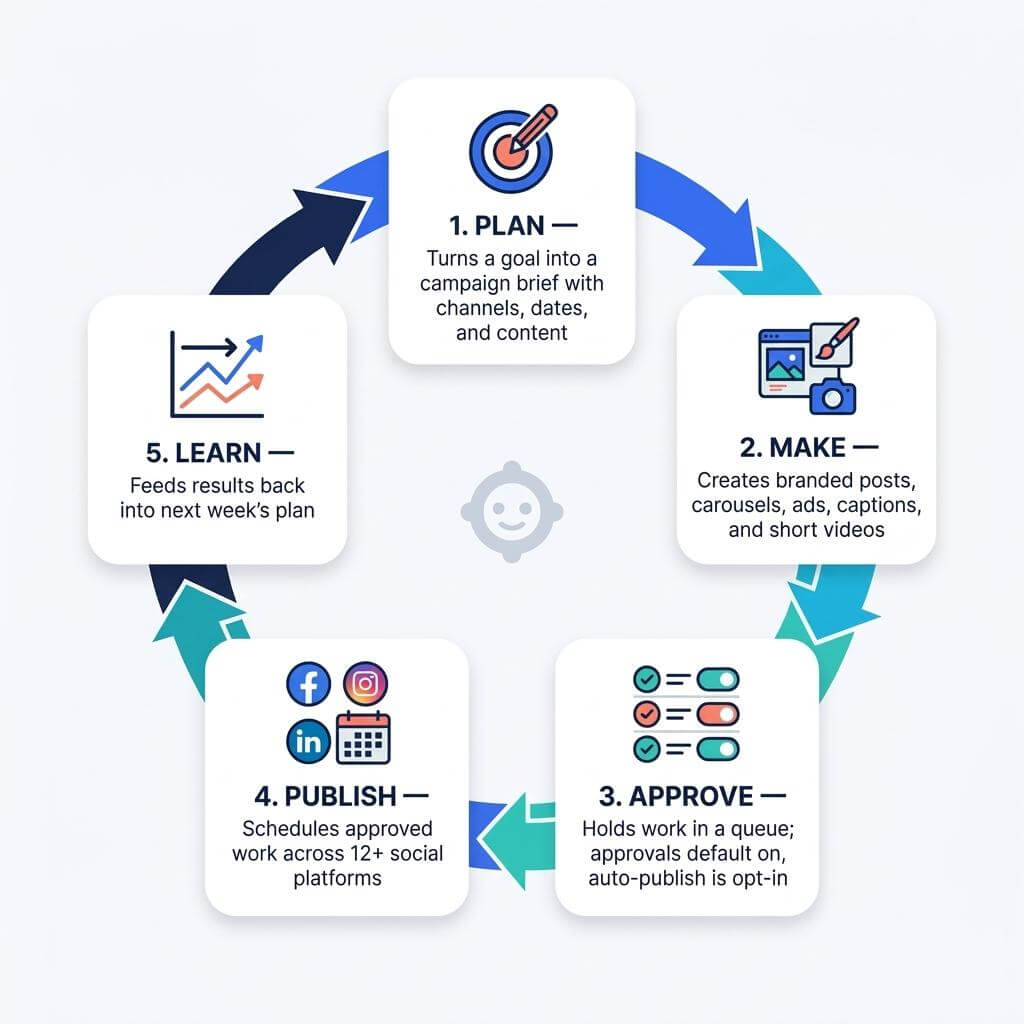
An AI marketing team works less like a CMO and more like the team a CMO would hire. Here’s the loop, using Simplified’s marketing agent, Riley, as the example:
- Plan. The agent turns your goal (“launch our spring menu”) into a campaign brief with channels, dates, and content.
- Make. It creates the posts, carousels, ads, captions, and short videos, using your brand memory: colors, fonts, voice, and approved examples.
- Approve. Everything waits in your queue. Approvals are on by default; auto-publish is opt-in, per workflow.
- Publish. Approved work goes out on schedule across 12+ social platforms.
- Learn. Results feed back into the agent, so next week’s plan builds on what worked.
Here’s how that plays out. Picture Jordan, the only marketer at a 12-person coffee roaster. On Monday Jordan asks for a launch campaign for a new single-origin bean. By Tuesday morning there’s a queue: six Instagram posts, three LinkedIn posts, a short product video, and captions in the brand’s voice.
Jordan rejects one post with a note (“too salesy”), approves the rest over coffee, and the campaign goes live Wednesday.
Jordan’s job changed from making to deciding. That’s the shift a CMO title alone doesn’t give you.
Already use Claude, Codex, or Cursor as your “AI CMO”? You can connect it to the Simplified MCP server, so the strategist you already use gets brand context, creative tools, approval gates, and publishing.
AI CMO tools compared: Okara vs. Simplified’s marketing agent, Riley
Okara is the best-known product built around the “AI CMO” name, so the Okara AI CMO is the fairest comparison. Here’s how the two stack up as of October 2026, based on each company’s own site:
| Okara (AI CMO) | Simplified’s marketing agent, Riley | |
|---|---|---|
| Positioning | “The AI CMO” with 10+ channel agents | AI agents for repeat marketing: plan, create, publish |
| Strongest at | SEO, GEO (AI search), Reddit, and community replies | Brand-consistent creative and multi-platform social publishing |
| Creative | Writing, plus AI UGC video clips | Design, video, copy, ads, and captions from your brand memory |
| Publishing | WordPress, Webflow, and other site builders, plus LinkedIn and X (TikTok/Instagram “soon”) | 12+ social platforms, with scheduling and analytics |
| Approvals | Drafts “for your approval” | On by default; auto-publish is opt-in |
| Agencies | Not advertised as a focus | Client workspaces, Brandbooks, and client review links |
| Starting price | From $129/month (free to start) | From $79/month, billed annually |
Choose Okara if…
- Organic search and AI search are your main growth channels
- You want agents that find Reddit threads and draft replies
- You publish a lot of blog content to WordPress or Webflow
Choose Simplified if…
- Social media, video, and visual content drive your business
- Brand consistency matters: same colors, fonts, and voice everywhere
- You want one approval queue for everything that ships
- You run an agency and need separate workspaces and client review
Some teams use both: a search-focused agent for organic growth and Simplified’s marketing agent, Riley, for the creative and social side. If search is your priority, our guide to choosing an AI SEO agent covers that half in depth. For a wider field, see how we compare AI marketing agents.
How to choose an AI CMO: five questions to ask
Before you pay for any AI CMO agent, run it through these five questions:
- Does it know your brand? Can you give it your logo, colors, fonts, voice, and examples of posts you love, and does it use them every time?
- Does it make finished work, or drafts? Ask for a real deliverable during the trial: a carousel, a video, a week of posts. If all you get is text, you’re still the designer.
- Does it publish where your audience is? Check the channel list against where your customers spend time, not the vendor’s roadmap.
- Where are the approval gates? You should be able to approve before anything goes live, and turn on auto-publish only where you trust it.
- What’s the all-in monthly cost? Count credits, seats, connected channels, and add-ons. A low starting price can climb fast.
If a tool passes all five, it’s acting like a team, not just a title.
FAQ
Can an AI CMO replace a real CMO?
Not entirely. An AI CMO can take over research, planning, drafting, and reporting, which is most of the hands-on work. Positioning, big budget calls, and taste still need a human. For most small businesses, the realistic goal is replacing the workload, not the judgment.
Is an AI CMO worth it for a small business?
It depends on what it delivers. An AI CMO that only produces plans is rarely worth it for a small team, because planning isn’t usually the bottleneck. One that also creates content and publishes it to your social channels, with your approval, takes most of the making and scheduling off your plate.
What’s the difference between an AI CMO and an AI marketing agent?
“AI CMO” is a title that emphasizes strategy. “AI marketing agent” describes software that carries out marketing tasks. In practice they overlap, so judge each tool by what it ships, not what it’s called.
How much does an AI CMO cost?
AI CMO tools typically start around $100-130 a month; Okara, for example, starts at $129. That compares with roughly $5,000-8,000 a month for a typical fractional CMO and a median salary of $166,790 a year for a full-time marketing manager. Check credit limits and add-ons before comparing list prices.
Can I use ChatGPT or Claude as my AI CMO?
Yes, for strategy. Both can research your market and draft a solid plan. They can’t publish or keep your brand consistent on their own. Connect one to a marketing platform, like the Simplified MCP server, and it can hand plans off for creation, approval, and publishing.
Bottom line: hire the team, not the title
An AI CMO is a useful idea with a misleading name. A CMO directs; a small business needs things done. So when you evaluate any AI CMO:
- Judge it by what ships, not by the strategy deck
- Insist on brand knowledge and approval gates before anything goes live
- Compare the all-in cost with a fractional CMO, not just with other tools
- Pick the tool that matches your main channel: search-first or social-and-creative-first
If your marketing runs on social, video, and visual content, you don’t need another plan. You need the marketing team you couldn’t afford to hire.