 By
By An AI content agent is AI software that runs your content process for you: it comes up with ideas, researches them, writes the copy, creates the visuals and videos, and schedules the posts, pausing for your approval before anything goes live. An AI writer gives you a draft. And an AI content agent gives you a published week.
If you’ve ever turned one good idea into actual posts, you know where the time goes. It’s not the idea. It’s the handoffs: the caption in one tool, the graphic in another, the video in a third, the scheduler in a fourth. One idea, six tabs, and your whole afternoon.
There’s also a fair worry. Ask on Reddit whether AI agents belong in content creation and you’ll hear the same fear again and again: more AI-generated sameness. That’s a real risk, and we’ll cover how to avoid it.
This guide explains what an AI content agent does, how it changes content marketing for small teams, how to keep quality high, and how to set one up.
Key Takeaways
- An AI content agent handles the whole content loop: ideas, research, writing, visuals and video, approval, and distribution.
- The biggest win for small teams is repurposing: turning one idea into a blog section, carousel, short video, and a week of posts.
- Quality depends on three inputs you control: your brand memory, your expertise, and your approval step.
- An AI writer or ChatGPT produces drafts; an AI content agent produces finished, scheduled content.
- Start with one channel and one weekly theme, then expand once the output sounds like you.
What is an AI content agent?
An AI content agent is an AI agent focused on content marketing. Like any AI agent, it works toward a goal, plans its own steps, and uses tools rather than answering one prompt at a time. Its goal is content that’s made, approved, and published, not just written.
You give it an objective, like “promote our new spring menu this week.” It figures out the posts, writes them, creates the graphics or short videos, and queues everything for your review.
AI content agent vs. AI writer vs. ChatGPT
These three get lumped together, but they do different jobs:
| AI writer | ChatGPT (assistant) | AI content agent | |
|---|---|---|---|
| What you give it | A prompt | A conversation | A goal |
| What you get back | A draft | Answers and drafts | Finished, scheduled content |
| Visuals and video | No | Some images | Yes, in your brand style |
| Publishing | No | No | Yes, after you approve |
| Remembers your brand | Limited | Within a chat | Yes, every time |
A good AI writer is still useful. Simplified’s AI blog writer, for example, is the right tool when you need a long-form draft fast. But a draft is only step three of six. If you’re wondering whether ChatGPT can cover the rest, we break that down in Riley vs ChatGPT: drafting content vs running the marketing job.
What an AI content agent does: the content loop
Every piece of content goes through the same loop. An AI content agent can run most of it:
- Ideas. It suggests topics based on your goals, seasons, product launches, and what’s worked before.
- Research. It pulls the facts, angles, and examples each piece needs.
- Writing. It drafts captions, posts, and scripts in your brand voice.
- Visuals and video. It creates graphics, carousels, and short videos using your colors, fonts, and logo.
- Approval. It holds everything for you to review, edit, or reject.
- Distribution. It schedules approved content across your channels at the right times.
Then there’s a seventh step that most tools skip: learning. A good content agent looks at what performed and feeds that into next week’s ideas.
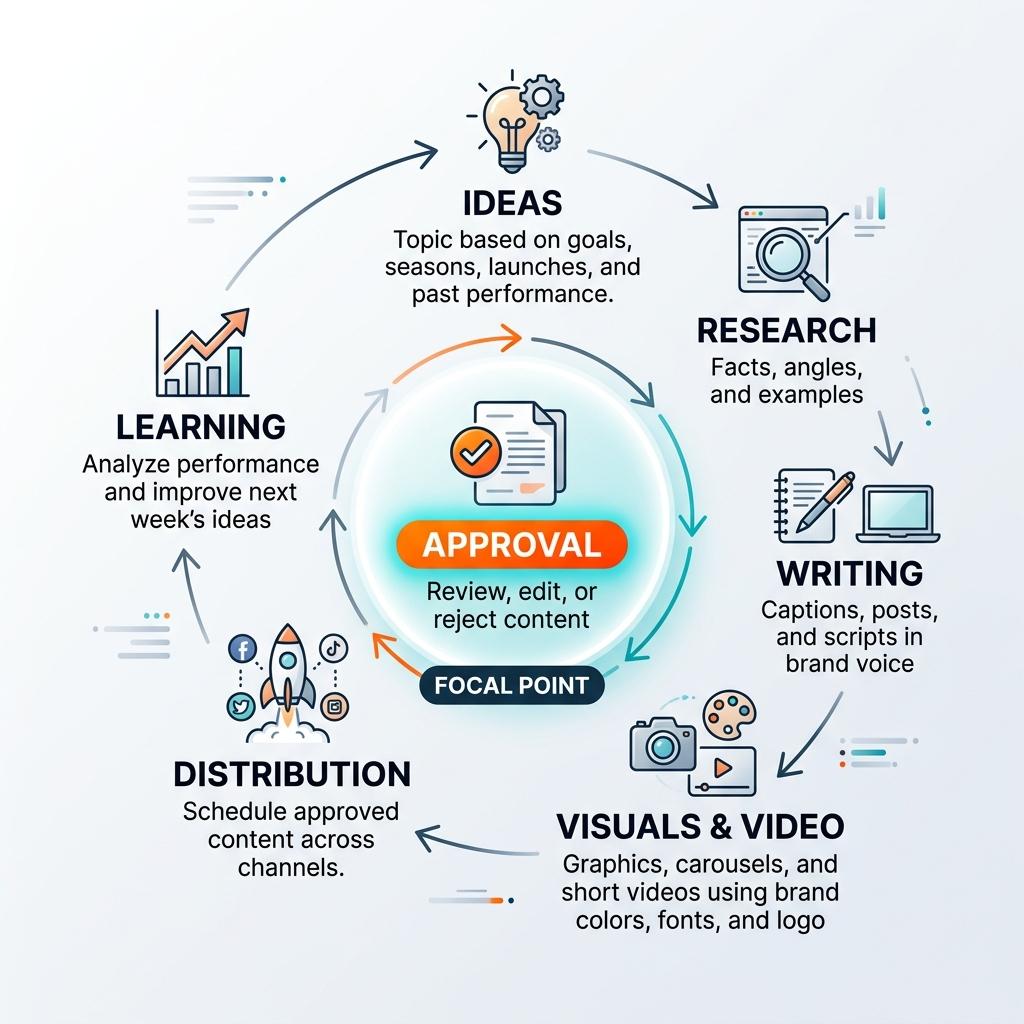
Most tools cover one or two of these steps. A writer covers step three; a scheduler covers step six. An AI content agent connects them, which is where the time savings come from. That’s the problem we explore in Riley vs Canva + Buffer: the handoffs between tools cost more than the tools.
How AI agents transform content marketing for small teams
For a big team, AI agents add capacity. For a small team, they change what’s possible.
Repurposing: one idea, ten formats
The single biggest win is repurposing. One good idea, say “three mistakes people make when buying their first road bike,” can become:
- A carousel for Instagram and LinkedIn
- A 30-second video for Reels and TikTok
- Three short posts for the week
- A caption set with hashtags
- A section of next month’s blog post
Doing that by hand takes most of a day. An AI content agent does the first pass in minutes, so your time goes into editing, not making.
Consistency: posting every week without burning out
Small businesses rarely fail at content because of bad ideas. They fail because posting stops when things get busy.
Picture Lena, who runs a three-person interior design studio.
She posted beautifully for two months, then a big client project hit and her Instagram went quiet for six weeks.
With an AI content agent, her Monday looks different. She spends 20 minutes approving a week of posts built from her project photos and design tips, and they go out on schedule while she’s on site. Her content doesn’t depend on her having a free afternoon anymore.
Want a content agent that makes and posts the work? Simplified’s marketing agent, Riley, plans the week, creates the posts and videos in your brand style, and publishes to your social channels after you approve. Start with Simplified’s marketing agent, Riley →
Will an AI content agent make your content generic?
It can, if you let it. AI-generated sameness happens when a tool has nothing to work from but a prompt. You can prevent it with three inputs:
- Brand memory. Give the agent your colors, fonts, voice, and examples of posts you love. The more specific, the less generic.
- Your expertise. Feed it your real material: customer questions, project photos, your opinions, your stories. The agent formats your knowledge; it shouldn’t invent it.
- Your approval. Review before anything ships. Cut what sounds off, and the agent learns from your edits.
Google’s own guidance takes the same view. It doesn’t penalize content for being AI-assisted; it cares whether content is helpful and made for people. Mass-produced filler is the problem, whoever makes it.
Here’s a simple test: if you could swap your logo for a competitor’s and nobody would notice, the content needs more of you in it.
What an AI content agent can’t do (yet)
AI content agents are strong at volume, format, and consistency. They’re weaker at the things that make your brand yours. Keep these with a human:
- Original opinions. An agent can format your take on an industry trend, but the take should come from you.
- First-hand stories. Customer wins, behind-the-scenes moments, and lessons learned need your input. Feed them in as notes or photos.
- Sensitive topics. Pricing changes, apologies, and anything legal or medical deserve a careful human edit.
- Long-form SEO research. Content agents are built for making and distributing. Keyword research and search briefs are a separate job.
Think of it as a division of labor. You bring the substance; the agent turns it into finished, on-brand content across every channel you use.
How to set up an AI content agent in 5 steps
You can have a content agent running in an afternoon. Here’s the setup, using Simplified’s marketing agent, Riley, as the example:
- Set up your brand. Add your logo, colors, fonts, voice, and three to five examples of content you’re proud of.
- Pick two or three content pillars. For example: tips, behind the scenes, and customer stories. This keeps ideas focused.
- Connect your channels. Start with the one or two platforms where your customers spend time.
- Set your approval rules. Keep approval on for everything at first. Turn on auto-publish later, only for content types you trust.
- Review weekly. Spend 20-30 minutes approving the week’s queue and noting what to change.
Picture Omar, a solo business consultant who wants to show up on LinkedIn without spending his evenings writing.
He sets up his brand, picks “client lessons” and “industry takes” as pillars, and asks for three LinkedIn posts and one carousel a week. After two weeks of edits, the drafts sound like him, and his Friday review takes about 15 minutes.
Choosing an AI content agent: what to look for
Not every tool marketed as an “AI content agent” covers the full loop. Before you choose, check:
- Does it make visuals and video, or just text? If it only writes, you still own the design work.
- Does it remember your brand every time? Look for stored brand kits and voice, not settings you re-enter per prompt.
- Does it publish where your audience is? Check the channel list against your actual channels.
- Is there an approval step? You should approve before anything goes live, with auto-publish only by choice.
- Does it learn from results? The best agents use performance data to shape next week’s plan.
If search traffic is your main goal, pair a content agent with research built for SEO; our guide to choosing an AI SEO agent covers that half. To compare options more broadly, see how we compare AI marketing agents, or start with our guide to AI marketing agents.
FAQ
What is an AI content agent?
An AI content agent is AI software that runs your content process: ideas, research, writing, visuals, video, and scheduling. It works toward a goal you set and pauses for your approval before publishing.
Is an AI content agent the same as an AI writer?
No. An AI writer produces text from a prompt. An AI content agent also creates the visuals and videos, keeps your brand consistent, and publishes the finished content after you approve it.
Can ChatGPT be an AI content agent?
Not on its own. ChatGPT is great for ideas and drafts, but it doesn’t keep your brand assets, design graphics in your style, or publish to your channels. You can connect it to tools that do, or use a content agent built for the whole job.
How much does an AI content agent cost?
Prices vary widely by how much of the loop the tool covers. Simplified plans start at $79 a month, billed annually. Compare tools by what’s included (seats, channels, video and design credits), not just the starting price.
Will AI-generated content hurt my SEO or my brand?
Not if it’s helpful and sounds like you. Google evaluates content quality, not whether AI helped make it. Protect your brand by giving the agent real examples and expertise, and by approving everything before it goes live.
The bottom line on AI content agents
An AI content agent doesn’t replace your ideas or your judgment. It replaces the handoffs that keep good ideas from becoming published content.
- Use it for the full loop: ideas, writing, visuals, video, approval, and distribution
- Lean on repurposing to turn one idea into a week of content
- Protect quality with brand memory, your expertise, and your approval
- Start small: one channel, two pillars, a weekly review
If your best ideas keep dying in your notes app, the bottleneck isn’t creativity. It’s everything after the idea.