 By
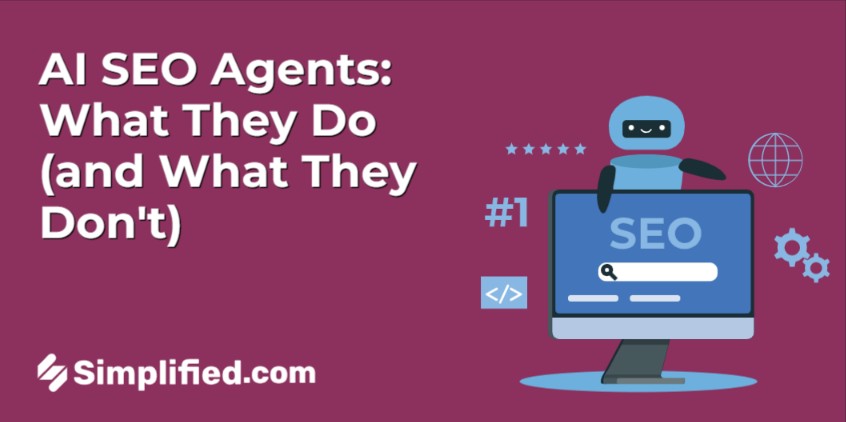
By An AI SEO agent is software that carries out multi-step SEO work on its own: keyword research, content briefs, technical audits, internal linking, and rank monitoring, using live search data. The good ones check in with you before they change anything. They’re reliable for research and audits, and risky when you let them publish without a human looking first.
That’s the short answer. The longer one matters, because “do AI SEO agents actually work?” is one of the top questions people ask about them on Reddit right now. The honest reply is: yes, for about half the job.
If you’re the one-person marketing team, you’ve probably felt the pitch. Hand SEO to an agent, wake up to traffic. We get the appeal. You’re already writing the newsletter, running the socials, and answering the “can you make a quick flyer?” requests.
This guide shows you what an SEO AI agent can take off your plate today, where it falls apart, and what it costs. We’ll also show you the workflow we use ourselves, because we run an AI SEO agent to plan the articles on this blog, including this one.
Key Takeaways
- An AI SEO agent does SEO tasks (research, briefs, audits, linking suggestions) instead of only answering questions about them. The best ones pause for your approval before acting.
- Agents are strongest at research and audits. They’re weakest at publishing unsupervised, where thin or inaccurate pages can trip Google’s scaled content abuse policy.
- Put three human checkpoints in any SEO agent workflow: approve the brief, approve the draft, approve the publish.
- Finding the right keyword is only half the work. For small teams, the real bottleneck is making the content well and getting it published and promoted.
- You can build a basic AI agent for SEO with Claude or ChatGPT plus an SEO data source for roughly $20-100/month, or buy a packaged tool that typically runs $99-999/month.
What is an AI SEO agent?
An AI SEO agent is an AI system that takes an SEO goal, such as “find content gaps for our blog,” and works through the steps on its own. It pulls search data, decides what to check next, uses tools, and produces a finished output. It differs from an AI SEO tool because it decides the next step, not you.
Here’s the simplest way to tell them apart:
| Chatbot (like ChatGPT) | AI SEO tool | AI SEO agent | |
|---|---|---|---|
| Who decides the next step? | You, every time | You | The agent |
| Uses live search data? | Usually not | Yes | Yes |
| Takes action? | No, it suggests | One task at a time | Chains many tasks |
| Who approves? | Nobody needs to | You, by doing the work | You, at checkpoints |
Ahrefs puts it plainly in their own guide to AI agents for SEO: a good SEO agent performs tasks rather than describing them, and usually includes human approval steps. It doesn’t have to be fully autonomous to be useful. That last point is the one most vendor pages skip.
AI SEO agents also sit inside a bigger shift. If you’re new to the idea of agents doing marketing work, our complete guide to AI marketing agents covers the full landscape. SEO is one job among many.
What an SEO AI agent can do for you
Most SEO AI agents cover some mix of five jobs. Few cover all five well, so check which ones a tool actually ships before you pay for it.
Keyword research and clustering
This is where agents shine. Give an AI SEO agent a seed topic and it can pull search volume and difficulty, find related terms, group them into clusters, and flag the easy wins. Work that used to take an afternoon in spreadsheets takes minutes.
For example, our own agent started this article from the phrase “ai seo agent.” It came back with the fact that the variant “seo ai agent” gets more searches (900 a month vs. 700) with lower difficulty. A human skimming one keyword tool could easily have missed that.
Content briefs and outlines
A content outline is where an SEO AI agent earns its keep. A good AI agent for SEO content creation reads the top 10 results for your keyword, notes what every page covers, and spots what they all miss. Then it turns that into a brief: target keyword, outline, word count, questions to answer, and links to include.
This is the most underrated use. A sharp brief makes the writing faster whether a human or an AI writes the draft.
Technical audits and fixes
Agents can crawl your site and flag broken links, missing meta descriptions, slow pages, and duplicate titles. Some can also draft the fix. Treat “draft” as the key word: a bad redirect or a mass meta-description rewrite can do real damage if nobody checks it first.
Internal linking
Agents are good at finding pages that should link to each other but don’t. They can scan your whole blog and suggest anchor text and placements in minutes. You still decide which suggestions make sense to a reader.
Rank and AI-search monitoring
The newest job is tracking whether AI tools cite you. Some SEO AI agents now log whether Google’s AI Overviews, ChatGPT, or Perplexity mention your brand for key prompts, alongside regular Google rankings. If that matters to you, our guide on how to get cited by ChatGPT covers what moves the needle.
Do AI SEO agents actually work? An honest answer
Yes, with a big condition. They work when a person approves the output at the right moments. They fail when you hand them the keys and walk away.
Where AI SEO agents are reliable
- Research at scale. Pulling and sorting hundreds of keywords is pure grunt work, and agents do it fast and accurately when they’re connected to real data.
- Pattern-spotting. Comparing 10 competitor pages and listing the gaps is a strength.
- Audits. Finding broken links or missing tags is rule-based work with clear right answers.
- First drafts of briefs and outlines. Fast, structured, and easy for you to correct.
Where they break
- Thin pages at scale. Some agents promise to publish dozens of pages a week. Google’s spam policies specifically target scaled content abuse: many pages made mainly to manipulate rankings, however they’re produced. Volume isn’t a strategy.
- Made-up facts. Agents can invent statistics, quotes, and product details with total confidence. Every number needs a source you can click.
- Publishing unsupervised. An agent with write access to your site can change hundreds of pages before you notice.
- Overpromising projects. Gartner predicts that over 40% of agentic AI projects will be canceled by the end of 2027, citing rising costs and unclear business value. Starting small helps you avoid becoming one of them.
Here’s a typical example of how that goes wrong. Picture Dana, who runs a two-person candle shop and bought an “autopilot” SEO tool in the spring. It published 60 blog posts in six weeks, all on long-tail keywords like “best soy candle for small bedroom.”
Traffic rose for a month, then dropped below where it started. When she finally read the posts, she found three that recommended a competitor’s wick size and one that invented a “2025 candle safety study.”
She deleted 52 of the 60 and now approves every brief before anything gets written.
The approval checkpoints that make agents safe
You don’t need to approve everything. You need three checkpoints:
- Approve the brief. Is this the right keyword and angle for your business? This takes two minutes and saves hours.
- Approve the draft. Check facts, claims about your product, and tone. This is where made-up stats get caught.
- Approve the publish. Final look at the title, URL, and links before it goes live.
[Visual: pipeline diagram showing Research → Brief ✓ → Draft ✓ → Publish ✓, with the three checkmarks as human checkpoints]
This is what people mean by human-in-the-loop, or “agentic SEO” done safely. Everything between those checkpoints can run on autopilot. That’s the sweet spot: the agent does the hours, and you make the calls.
How we use an AI SEO agent (a real workflow)
We don’t just write about this. The articles on this blog start in an AI SEO agent we built ourselves using Claude, live Ahrefs data, and our own brand and SEO guidelines. Here’s the actual workflow that produced this article.
- Prioritize. The agent checked our existing content plan against live search data. It flagged that searches for “ai seo agent” had nearly tripled since July (from 260 to 700 a month) while we had nothing ranking for it.
- Research. It pulled the top 10 results, read the leading guides, and pulled 30 related keywords. It found that a site with a domain rating of 43 holds the #1 spot. That’s a signal the topic is winnable.
- Brief. It wrote a full brief: angle, outline, keyword targets, and gaps to fill. The biggest gap it found? Nobody gave a straight answer to “do these actually work?” That became the section you just read.
- Human checkpoint. A person on our team approved the topic and angle before a single word of the draft was written.
- Draft, then review. The draft went through automated quality checks, then human editing.
The biggest lesson? The agent removed the research bottleneck, not the publishing one. Research that used to take a day now takes minutes. But we’ve still watched finished drafts sit in a review queue for weeks, because editing, designing, publishing, and promoting all still needed someone’s time.
That gap is the part most AI SEO agent guides skip.
The half an SEO agent doesn’t do: making and shipping the content
An SEO agent tells you what to write. Then someone still has to:
- Write a draft that sounds like your brand, not like a robot
- Create the featured image and in-article graphics
- Publish it to your site with the right title, URL, and meta description
- Turn it into a LinkedIn post, a carousel, and a short video so people actually see it
- Schedule all of it
For a small team, that list is the real time sink. It’s also where Simplified fits, and it’s worth being clear about what we are and aren’t.
What we’re not: an SEO data tool. Simplified doesn’t do rank tracking or backlink analysis, and we won’t pretend otherwise. Keep using your SEO agent or keyword tool for that half. (If you’re weighing agents that cover the rest of marketing, we compared the best AI marketing agents side by side.)
What we are: the half after the brief. Simplified’s marketing agent, Riley, takes your approved brief and runs the making-and-shipping work:
- Works from your brand memory: colors, fonts, voice, and approved examples
- Drafts the copy (Simplified’s AI blog writer handles long-form), then creates the visuals, social posts, carousels, and short videos to promote it
- Queues everything for your approval. Nothing ships without your OK, and auto-publish is opt-in.
- Publishes approved posts across 12+ social platforms on schedule, then reports back on what worked so the next plan is smarter
Here’s what the full loop can look like. Picture Marcus, who runs a five-client agency, and this weekly rhythm.
On Monday his SEO agent produces a brief for each client. On Tuesday he approves them over coffee. By Wednesday, each client’s approval queue has the visuals and a week of social posts to promote the new article. He spends Thursday editing, not starting from blank pages.
His team went from promoting four client articles a month to 12 without hiring.
Have a brief ready? Let Simplified’s marketing agent, Riley, turn it into on-brand content and a week of social posts, with you approving every piece. Start with Simplified’s marketing agent, Riley →
How to choose an AI SEO agent (build vs. buy)
You have two real options for getting an SEO AI agent. Neither is wrong. It depends on your time and comfort with tech.
Build your own SEO agent
What it is: An AI assistant like Claude or ChatGPT, connected to an SEO data source through MCP (a standard way to plug tools into AI) or an API, plus written instructions for your workflow.
Cost: Roughly $20-100/month for the AI subscription plus pay-as-you-go data. If you’re just starting, our roundup of free keyword research tools can keep data costs near zero.
Best for: People comfortable writing detailed instructions and tinkering. You get full control and pay only for what you use.
Watch out for: Setup time. Expect a few days to get something reliable.
Tip: If you build on Claude, Codex, or Cursor, you can connect the Simplified MCP server to the same assistant. The connector is free and open source. Your SEO agent finds the topic and writes the brief, then hands the making and scheduling to Simplified, with drafts held for your approval. That’s the setup we use.
Buy a packaged AI SEO agent
What it is: A ready-made product with the workflows built in.
Cost: Vendor pricing we found ranges from about $99/month for a single site to $999/month for agency plans. [Verify current pricing before publishing.]
Questions to ask before you buy:
- Does it have an approval mode? If it can only publish automatically, walk away.
- Where does its data come from? Real search data beats AI guesses about search volume.
- What can it change on my site? Read-only access is safer while you’re learning.
- Can I export everything? Your briefs and research should be yours.
AI SEO agents for agencies and startups
Agencies should look for separate workspaces per client and per-client approval gates. Doing one client’s SEO with another client’s keywords is a mistake you only make once.
Startups usually get the most from building their own. Early on, you need a few strong pages, not volume. Start with one workflow, such as weekly content briefs, and add more once it’s working. If you want to wire agents together without code, AI workflow automation lets you add human approval steps between each one.
[YouTube embed: insert our own “AI SEO agent workflow” walkthrough, or an independent, non-competitor tutorial on building an SEO agent]
FAQ
Can an AI agent do SEO on its own?
Partly. An AI agent can handle keyword research, content briefs, audits, and internal-link suggestions on its own. It shouldn’t publish or change your site without a human check. The best setup lets the agent do the legwork and saves the final decisions for you.
Will Google penalize content made by an AI SEO agent?
Not for being AI-made. Google cares about whether content is helpful, not who or what wrote it. But mass-producing thin pages mainly to rank violates its scaled content abuse policy, no matter how they’re made. Review every page before it goes live.
What’s the best AI agent for SEO strategy?
The best AI agent for SEO strategy is one connected to real search data, with an approval step before anything changes. For most small teams, that means a general AI assistant plus an SEO data source, or a packaged tool with an approval mode. Avoid any tool that only offers autopilot publishing.
How much does an AI SEO agent cost?
A do-it-yourself AI SEO agent typically costs $20-100/month in AI and data fees. Packaged tools usually run $99-999/month depending on how many sites and keywords you track. Add the cost of the human time to review output either way.
Can I build my own SEO agent with ChatGPT or Claude?
Yes. Connect the assistant to an SEO data source, write clear step-by-step instructions, and start with one task, like content briefs. That’s how we built ours. Expect a few days of setup and tweaking before it’s reliable.
Bottom line: use an AI SEO agent for the research, keep a human on the decisions
An AI SEO agent is worth it in 2026 if you use it for what it’s good at:
- Research and briefs: hand these off and get hours back every week
- Audits and linking: let the agent find the issues, then approve the fixes
- Publishing: keep three human checkpoints (brief, draft, publish)
- The making and shipping: remember this is the half SEO agents don’t do
Start with one workflow this week. Have an agent write your next content brief, then compare it with the last one you wrote by hand.
And when the brief is ready, you don’t have to build the rest alone. Simplified’s marketing agent, Riley, turns approved briefs into on-brand content, visuals, and social posts, then schedules the approved posts across your social channels when you say go.