 By
By 
There’s a very specific kind of exhaustion that comes from marketing in 2026. It’s not the creative burnout everyone warns you about. It’s the logistics burnout. You wrote a great caption. Cool. Now get your manager to approve it, resize it for four platforms, schedule it at the right time in each timezone, check whether it actually worked, and do all of that again tomorrow. And the day after. Forever.
Somewhere in the middle of all that, someone on your team opened ChatGPT and said “just write me something,” and for a minute, things felt easier. That’s not a coincidence — ChatGPT really is good at writing. But here’s the uncomfortable truth most marketing teams eventually bump into: writing was never actually the bottleneck. Getting that writing turned into a finished, approved, published, and measured piece of marketing — that’s the bottleneck. And that’s a completely different job.
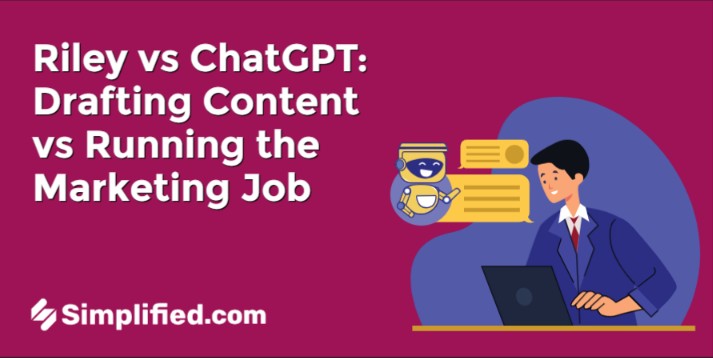
This is really what the Riley (Simplified’s AI marketing agent) vs ChatGPT conversation comes down to. One of them writes you a draft. The other one runs your campaign. Let’s actually walk through the difference, because it matters more than most “AI comparison” posts want to admit.
What This Blog Covers
- Why “writing the content” was never the actual bottleneck — and what’s really eating your team’s time every week
- What ChatGPT is genuinely great at, and where that usefulness runs out
- The four places campaigns quietly break down between a finished draft and a published post
- An introduction to Riley — what it actually is and how it’s different from a chatbot
- A side-by-side comparison table of what ChatGPT and Riley each handle
- How approvals actually work with Riley — so nothing ships without your sign-off
- Who this matters most for — founders, lean teams, agencies, and teams already using AI assistants
- FAQs
The Job Was Never Just “Write This”
Picture the last five pieces of content your brand shipped — a launch post, a product email, a TikTok script, whatever. Now mentally rewind and count every single hand that touched it before it went live.
Someone drafted it. Someone edited it to actually sound like your brand instead of a generic corporate blog (we see you, “In today’s fast-paced digital landscape”). Some person designed a visual to go with it. Someone routed it to a manager, or three managers, for approval. Someone scheduled it, at the right time, on the right platform, in the right format, because Instagram and LinkedIn have never agreed on an aspect ratio in their lives. And a week later, someone should check whether it worked and feed that back into the next plan — a step that, let’s be honest, usually just… doesn’t happen, because everyone’s already three tasks deep into the next fire.
Writing the actual words is maybe a fifth of that. ChatGPT is fantastic at that fifth. It is not built to do the other four-fifths, because it was never designed as a marketing execution system — it was designed as a conversation. A very smart, very fast conversation, but a conversation nonetheless. It doesn’t have a brand kit. Even it doesn’t remember that your last campaign flopped because you posted during a holiday weekend. It can’t hit “approve” on behalf of your manager, and it definitely can’t publish anything anywhere. It writes the caption and then, politely, hands you back the rest of your job.
Let’s Give ChatGPT Its Due
This isn’t a takedown piece. ChatGPT earned its spot in a million browser tabs for a reason. It’s genuinely excellent for:
- Brainstorming ten headline options when your brain has produced exactly zero
- Rewriting that one paragraph you’ve been stuck on for twenty minutes
- Summarizing a competitor’s blog post so you don’t have to read the whole thing
- Acting as a sounding board when you just need to talk an idea out
If your job is “occasionally I need help writing something,” ChatGPT does that job well. Nobody’s asking you to close the tab.
But if your job is “I need to run marketing” — meaning you have to plan it, create it, win approval for it, publish it everywhere it needs to go, and learn from what happened — that’s not a writing job anymore. That’s an operations job wearing a content costume. And that’s exactly the gap that sends people searching for a proper ChatGPT alternative for marketing in the first place.
Where the Cracks Actually Show Up
It’s easy to say “ChatGPT doesn’t do the whole job” in the abstract. Here’s what it looks like on an actual Tuesday:
The brand voice problem. You paste in a paragraph of brand guidelines every single time, because ChatGPT doesn’t remember your brand voice from one chat to the next unless you rebuild the context yourself. Multiply that by every team member who uses it, and you’ve got five slightly different “on-brand” outputs from five different prompt styles.
The approval black hole. ChatGPT writes the draft. Then it lives in a Google Doc, or a Slack thread, or an email, waiting for someone to notice it, review it, and approve it. That waiting is invisible to ChatGPT. It has no idea the draft is stuck. It has already moved on to helping someone else write a haiku about their cat.
The publishing gap. Even a perfect, approved draft still has to physically get onto Instagram, LinkedIn, TikTok, and wherever else your audience lives. ChatGPT cannot do that. Someone — you, again — has to copy it out, format it, and post it manually, at 11pm, across five tabs, because that’s apparently when marketing content gets published now.
The memory problem. Great, last month’s campaign got 40% more engagement on Thursdays. Does ChatGPT know that? No. Will it apply that insight automatically to next month’s plan? Also no. That insight lives in your head, or in a spreadsheet nobody opens, instead of feeding directly into what happens next.
None of this is a knock on ChatGPT’s writing ability. It’s just proof that drafting and running a campaign are two very different jobs, and only one of them has historically had a tool built specifically for it.
Bonus: Riley vs Canva + Buffer: Can One AI Agent Replace the Content Handoff?
Enter Riley: The Part That Actually Runs the Job
Before going further, it’s worth actually explaining what Riley is, since the name alone doesn’t give much away. Riley is Simplified’s AI marketing agent — not a chatbot you prompt for drafts, but a system built to run an entire campaign from brief to published post. Think of it less like a writing assistant and more like the teammate who takes your one instruction and actually gets the whole job done.
This is where Simplified’s approach looks fundamentally different from ChatGPT. Riley isn’t positioned as “a chatbot that also does marketing.” It’s build as the team — the thing that takes a single brief and moves it through the entire lifecycle of a campaign: planning, creating, approving, publishing, and reporting, not just the writing stage.
Here’s what that actually looks like in practice:
You brief Riley once. Instead of prompting five separate times across three different tools, you give Riley the goal, the audience, the offer, the channels, and the brand rules — one time. That single brief becomes the seed for everything that follows.
Riley builds the campaign, not just the copy. It pulls in your brand memory — colors, tone, past approved posts, the products you sell — so the output already sounds and looks like you before a human even opens it. It creates the copy, the visuals, the video, the captions, all pulled together as a campaign instead of a loose stack of drafts you’d otherwise have to assemble yourself.
You approve it, your way. This part matters, especially if the idea of an “AI agent doing your marketing” makes you a little nervous. Nothing publishes without your review unless you specifically turn on auto-publish for that workflow. You can reject a draft with one tap, and the whole point is that Riley gets closer to your voice with every approval and rejection, instead of forgetting everything the moment the chat window closes.
Riley actually publishes it. Approved work moves to the right channel, at the right time, in the right format, without you manually resizing a graphic at midnight. This is the step that ChatGPT simply cannot do, no matter how good the caption underneath it is.
Riley reports back — and remembers. After the campaign runs, Riley shows you what worked and what didn’t, and that performance data actually feeds the next plan. Last week’s campaign becomes the starting point for next week’s brief, instead of a screenshot buried in someone’s camera roll.
And if you want to automate the repeat work, you can. Weekly content plans, recurring reports, the stuff you do every single week without fail — set Riley up to keep that loop moving on a schedule, so it doesn’t eat a chunk of someone’s Monday morning every single week.
Side by Side, No Spin Needed
| ChatGPT | Riley (Simplified) | |
|---|---|---|
| Writes drafts | Yes, very well | Yes |
| Remembers your brand voice automatically | No, you re-explain it each time | Yes, via brand memory |
| Builds full campaign assets (copy, design, video) | No | Yes |
| Routes work for approval | No | Yes, with approval gates |
| Publishes to social channels | No | Yes, across connected platforms |
| Reports on performance and applies it to the next plan | No | Yes |
| Automates recurring campaign work | No | Yes |
Looking at that table, it’s not really a fair fight, because the two tools simply don’t do the same job. That’s kind of the point.
“But What If It Posts Something Embarrassing?”
Fair question, and one worth answering directly instead of dodging with marketing fluff. Nothing goes live unless you approved it, or you specifically opted into auto-publish for that particular workflow. If a draft is bad, you reject it, and that rejection is information Riley uses next time. You’re not handing over the keys and walking away — you’re just no longer the one manually checking every single tire before every single drive.
And ownership-wise, everything created — copy, designs, video, captions — belongs to your account. That doesn’t change even if you cancel later.
Bonus: What is ChatGPT advertising? Everything marketers need to know
Who This Actually Matters For
If you’re a solo founder or a lean team trying to run marketing without hiring a full department, the appeal is obvious: you get a plan-create-post-report loop without needing five separate specialists on payroll.
If you’re running an agency, the workspace model matters even more — each client can have their own brand, channels, calendar, and approval flow, without you rebuilding your entire process every time you onboard someone new.
And if your team already leans on Claude, Codex, or another AI assistant for planning and strategy, Riley doesn’t ask you to abandon that. Simplified connects through an open MCP server and API, so your existing agent can hand off the actual execution — the approvals, the publishing, the reporting — to a system built specifically to run it.
So, Riley or ChatGPT?
Honestly, that framing is a little unfair to ChatGPT. It’s not that one tool is “better” than the other in some universal sense — it’s that they’re solving different problems. ChatGPT is the assistant that helps you think and write. Riley is the one that takes what got written and actually turns it into a shipped, approved, measured campaign.
If all you need is help writing a caption once in a while, keep that tab open. But if you are quietly hunting for a ChatGPT alternative for marketing — something that doesn’t stop the moment it finishes the draft and leave you to handle everything after — that’s a different category of tool entirely, and Riley was actually built for exactly that.
The draft was never the hard part. Getting it out the door was. Might be time to hand that part to something that was actually built for it.
Frequently Asked Questions
Riley vs ChatGPT — which one is actually better for marketing?
They’re not really built for the same job, so “better” depends on what you need to do. ChatGPT handles writing and brainstorming — it drafts fast, rewrites quickly, and bounces ideas around. Riley runs the campaign that comes after the draft — it matches your brand, routes approvals, publishes posts, and reports on results. Most teams asking this question aren’t choosing between two writers — they’re choosing between a writer and a team.
Can ChatGPT do everything Riley does if I just prompt it well enough?
No, and this isn’t about prompting skill. ChatGPT has no memory of your brand kit between chats, no way to route a draft for approval, no connection to your social channels, and no ability to publish anything. Better prompts get you a better draft. They don’t get you a published, approved campaign.
Does Riley write as well as ChatGPT?
Writing quality is comparable, but the comparison undersells the point — Riley matches your brand voice automatically using your actual Brand Kit, and it attaches that writing to a finished campaign (design, captions, scheduling) instead of leaving you to build everything around a block of standalone text.
If ChatGPT is free (or cheaper), why would I need Riley?
Because the real cost was never the subscription — it’s the hours you spend manually turning a ChatGPT draft into something that matches your brand, clears approval, fits each platform’s format, and actually publishes. Riley’s pricing replaces that whole workflow, not just the writing step, so the comparison isn’t apples to apples.
Can I use ChatGPT and Riley together, or do I have to pick one?
You can absolutely use both. A lot of teams keep ChatGPT (or Claude) for early brainstorming and strategic thinking, then connect it to Riley through MCP or API so the execution side — approvals, publishing, reporting — runs automatically instead of someone manually copying drafts over.
Will switching from ChatGPT to Riley mean giving up control over what gets published?
No — if anything it’s the opposite. With ChatGPT, there’s no built-in approval step; someone has to manually review everything before it goes anywhere. Riley bakes that review into the workflow itself, and nothing publishes unless you’ve approved it or specifically opted into auto-publish for that task.
Does Riley remember past campaigns the way ChatGPT remembers a conversation?
Further, actually. ChatGPT’s memory is limited to context within a session unless you re-explain things each time. Riley retains your brand memory and campaign performance permanently, and uses what worked (or didn’t) to shape the next plan automatically.
Is Riley just “ChatGPT with extra steps,” or is it a genuinely different kind of tool?
Genuinely different. ChatGPT is a conversational assistant you prompt. Riley is an agent that takes one brief and independently moves it through planning, creation, approval, publishing, and reporting — closer to delegating a task to a teammate than typing into a chat box.
I’ve been using ChatGPT for drafts and still doing everything else manually — is that normal, or am I missing something?
Completely normal, and it’s exactly the gap this comparison is about. ChatGPT was never designed to handle the publishing, approvals, or reporting side — that manual work isn’t a sign you’re doing something wrong, it’s just the part ChatGPT was never built to cover.
What’s the easiest way to actually compare the two instead of just reading about it?
Give both the same brief. Ask ChatGPT to draft a campaign post, then hand Riley the same brief and see what comes back — one gives you a draft, the other gives you a draft, design, approval flow, and a scheduled post. The difference tends to be obvious within a single run.