By
By 
Social media marketing used to mean late nights, endless spreadsheets, and the constant fear of missing a posting window. Now, AI agents are handling the heavy lifting while marketers focus on strategy and creativity.
But here’s the thing most articles won’t tell you: not all AI in marketing is created equal. Some tools genuinely transform workflows. Others are fancy autocomplete with a subscription fee.
In this guide, we’ll cut through the noise. You’ll learn exactly how AI agents are reshaping social media marketing, what’s actually working for small businesses in 2026, and how to separate the signal from the hype.
What Are AI Agents in Marketing?
AI agents are software systems that don’t just respond to commands. They take autonomous action to complete tasks.
Unlike traditional AI tools that wait for your input, agents can plan, execute, and adapt their approach based on results.
Think of the difference this way:
Traditional AI tool: You type “write me an Instagram caption about our new product.” It writes one caption. Done.
AI agent: You say “create this week’s social content for our product launch.” It analyzes your brand voice, checks your content calendar, generates posts for each platform, schedules them at optimal times, and monitors initial engagement to suggest adjustments.
The shift is real, and the data backs it up. According to Salesforce’s Slack Workforce Index, daily AI users report 64% higher productivity than colleagues who don’t use AI daily — a gap that’s only widened as agents (not just chat tools) have entered the picture.
AI agents in marketing typically handle:
- Content generation across multiple formats and platforms
- Scheduling and publishing at algorithm-optimized times
- Performance analysis with actionable recommendations
- Audience research and competitor monitoring
- Campaign coordination across channels
The technology has matured past the “interesting experiment” phase. It’s now a practical tool that budget-conscious teams use daily.
The Moltbook Moment: Why This Topic Got Bigger in 2026
Something happened in early 2026 that changed how seriously people take “AI agents” as a phrase, and it’s worth understanding even though it isn’t a marketing tool itself.
An open-source personal AI agent framework called OpenClaw went viral for actually completing tasks — managing calendars, sending emails, shopping online — instead of just chatting. That led to Moltbook, a Reddit-style social network built entirely for OpenClaw agents to post and interact with each other, with humans watching from the sidelines.
Moltbook grew to over a million active agents within weeks. Meta acquired it in March 2026.
Why does this matter for social media marketing specifically? Two reasons.
First, it normalized the idea of agents acting on someone’s behalf at scale. A million autonomous agents posting, replying, and interacting with each other made “AI agent” a mainstream concept practically overnight, not just an industry buzzword. That shift in public familiarity makes it easier to introduce agent-based tools into your own marketing stack without a long explanation.
Second, it’s a real security lesson, not a hypothetical one. Researchers flagged Moltbook as a live example of indirect prompt injection — malicious instructions hidden in content an agent reads, then treated as legitimate commands. If your social media agent reads comments, DMs, or external links as part of its workflow, that’s a genuine risk to build guardrails around, not just a theoretical concern.
None of this changes the practical advice in the rest of this guide. It’s context for why “AI agent” carries more weight in 2026 than it did even a year ago.
How AI Agents Are Transforming Social Media Workflows
From Manual Posting to Intelligent Automation
The old social media workflow looked like this: brainstorm ideas, write posts individually, design graphics in one tool, write copy in another, schedule in a third, then track results in a fourth.
Every platform needed separate formatting. Every task required context-switching.
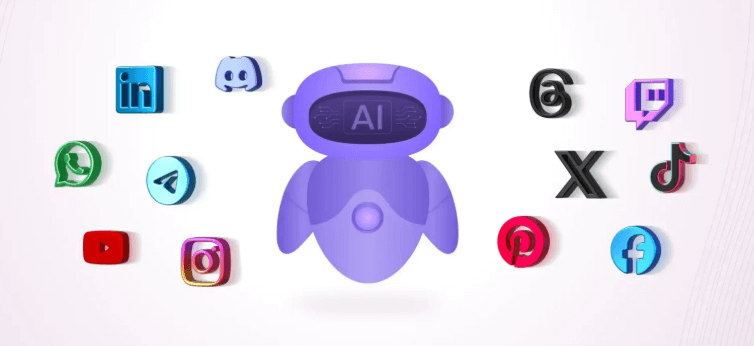
AI agents collapse this into a single workflow. Modern social media management platforms with AI capabilities can take a content brief and produce platform-specific posts — complete with graphics, captions, and optimal scheduling times. One input, multiple outputs, no copy-paste marathon.
The time savings are substantial. Teams that previously spent 10-15 hours weekly on content creation and scheduling report cutting that to 2-3 hours. For small businesses, that’s 8-12 hours back for actually running the business.
Content Creation at Scale
Volume is a constant challenge in social media. Algorithms favor consistent posting. Audiences expect fresh content. But creating enough quality posts to feed multiple platforms exhausts small teams quickly.
AI agents address this through:
Batch generation: Create a week or month of content from a single strategy session. AI writing tools can generate dozens of post variations, then let you curate the best ones.
Content repurposing: One long-form piece becomes multiple social posts. A blog article transforms into a carousel, thread, video script, and story series, automatically formatted for each platform.
Brand voice consistency: Well-configured AI maintains your tone across hundreds of posts. Set up your brand guidelines once, and every generated piece follows them.
Smart Scheduling and Optimization
Posting time matters. The difference between publishing at 9 AM versus 2 PM can mean thousands of additional impressions. But optimal times vary by platform, audience, and even day of week.
AI agents analyze your historical performance data, audience activity patterns, and platform-specific trends to schedule posts when they’ll perform best. This isn’t generic “best times to post” advice — it’s personalized to your actual audience behavior.
Social media schedulers with AI capabilities can:
- Identify when your specific followers are most active
- Adjust recommendations as patterns change
- Queue content for consistent presence without daily manual work
- Bulk schedule hundreds of posts while maintaining quality
For small businesses managing multiple platforms, this automation eliminates one of the most tedious parts of social media management.
Meet Riley: An Agent Built Specifically for This
Most of what’s described above requires stitching several AI tools together yourself. Simplified’s AI marketing agent- Riley, is built to handle that stitching for you.
Give Riley a brief — the goal, the audience, the channels — and it plans the content calendar, drafts platform-specific posts, generates matching visuals using your Brand Kit, and queues everything for your approval before it publishes. You’re still the one saying yes or no. Riley just removes the manual handoffs in between.
One detail worth knowing if your team already works inside AI tools: Simplified runs an MCP server, so Claude, Codex, or Cursor can trigger Riley’s workflows directly, without switching into a separate app.
What’s Actually Working: AI Marketing Wins in 2026

Not everything labeled “AI” delivers results. Here’s what’s genuinely moving the needle for social media marketers this year.
Integrated Content Workflows
The biggest wins come from integration, not individual tools. Teams using all-in-one platforms that combine AI writing, design, and scheduling outperform those using separate best-of-breed tools.
Why? Context. An AI that understands your brand, your recent posts, your content calendar, and your performance data makes smarter suggestions than one that only sees the current task.
Practical example: you need to promote a webinar. An integrated agent can:
- Reference your brand voice guidelines
- Check what’s already scheduled to avoid redundancy
- Generate posts for each platform in appropriate formats
- Include properly sized graphics using your brand assets
- Schedule the promotional sequence leading up to the event
- Suggest follow-up content based on registration numbers
That’s one workflow. With separate tools, it’s five or six disconnected tasks.
AI-Powered Content Repurposing
The highest ROI use of AI in social media isn’t creating from scratch. It’s multiplying what you already have.
One podcast episode becomes:
- Audiogram clips for Instagram and TikTok
- Quote graphics for LinkedIn and X
- A blog post summary
- Thread-style breakdowns
- Email newsletter content
One blog post becomes carousel slides, short-form video scripts, social proof snippets, and discussion prompts.
AI agents can identify the most engaging segments of long-form content and reformat them automatically. This isn’t lazy marketing. It’s a smart distribution that ensures your ideas reach audiences across platforms where they consume content differently.
Personalization at Scale
Generic posts get generic results. AI enables personalization that would be impossible manually.
This shows up in:
Audience segmentation: AI analyzes your followers and identifies distinct groups with different interests, then helps tailor content for each.
Dynamic content: Posts that adapt based on engagement patterns, time of day, or trending topics.
Response optimization: AI suggests reply templates and engagement strategies based on what’s driven the best results historically.
Small businesses can now deliver the personalized experience that audiences expect from major brands, without the major brand budget
What’s Overhyped: AI Marketing Myths to Avoid
For every legitimate AI marketing capability, there’s a vendor overpromising results. Here’s what isn’t working as advertised.
“Fully Autonomous” Marketing
No AI agent should run your marketing completely unsupervised. The technology isn’t there, and frankly, it shouldn’t be.
AI excels at execution and optimization. Strategy still requires human judgment. Understanding your market, making creative leaps, navigating sensitive topics, building genuine relationships — these remain human work.
The effective model is AI handling 80% of the execution so you can focus 80% of your time on the 20% that matters most.
One-Click Viral Content
If any tool promises guaranteed viral content, run. Virality depends on cultural timing, audience resonance, and factors no AI can predict reliably.
AI can improve your odds by identifying trending formats, optimizing headlines and hooks, suggesting engagement-driving elements, and testing variations quickly.
But “one-click viral” is a marketing fantasy. Consistent, quality content beats chasing virality every time.
AI That “Knows” Your Audience Without Data
AI needs training data to work effectively. A new AI tool knows nothing about your specific audience until you feed it information.
Be skeptical of claims about instant audience insights. Good AI marketing requires historical performance data from your accounts, clear brand guidelines, ongoing feedback to improve outputs, and time to learn what works for your specific context.
The best AI tools get better the more you use them. Day one results are rarely representative.
Replacing Human Creativity Entirely
AI generates content. Humans create meaning.
The most effective social media strategies use AI to handle volume and consistency while humans provide creative direction, brand personality, emotional intelligence, cultural awareness, and authentic connection.
AI is a creative multiplier, not a creative replacement.
How to Actually Use AI Agents for Social Media Marketing

Start With Your Bottleneck
Before adopting any AI tool, identify your actual constraint. Common social media bottlenecks:
Time: You know what to post but can’t create enough content
- Solution: AI content generation and batch scheduling
Ideas: You struggle to come up with fresh content angles
- Solution: AI brainstorming and trend analysis
Consistency: Your posting schedule is erratic
- Solution: AI-powered scheduling and calendar management
Performance: You post regularly but results are flat
- Solution: AI analytics and optimization recommendations
Tool sprawl: You’re juggling too many platforms and subscriptions
- Solution: All-in-one platforms with integrated AI
Solving the right problem matters more than having the fanciest AI.
Choose Integration Over Point Solutions
The math on marketing tools has changed. Previously, best-of-breed specialists made sense. Now, integration advantages often outweigh specialized features.
Consider the workflow for posting a single piece of content with separate tools:
- Write in an AI writing tool (~$49/month)
- Design in a graphic design tool (~$15/month)
- Schedule in a social media manager (~$99/month)
- Track in an analytics platform (~$50/month)
That’s roughly $213/month, four logins, four learning curves, and constant copy-paste between systems. An integrated platform collapses all four steps into one workspace. You lose some specialized depth, but gain workflow efficiency that saves hours weekly. For most small businesses, the trade-off favors integration — and an agent that coordinates the handoffs saves further time on top of that.
AI workflow automation takes this further by connecting your marketing tools to your broader business systems – CRM, email, customer support, and more.
Set Up Your Brand Foundation First
AI outputs are only as good as their inputs. Before generating content at scale:
Document your brand voice: How do you sound? Formal or casual? Witty or straightforward? What words do you use? What do you avoid?
Establish visual guidelines: Colors, fonts, logo usage, image style. AI design tools need these parameters.
Define your content pillars: What topics do you cover? What’s off-limits? What ratio of promotional to educational content?
Clarify your audience: Who are you talking to? What do they care about? What problems do they have?
This upfront work pays dividends. Well-configured AI produces usable content immediately. Poorly configured AI produces generic content that needs heavy editing.
AI outputs are only as good as their inputs. Before generating content at scale:
Document your brand voice. Formal or casual? Witty or straightforward? What words do you use, and what do you avoid?
Establish visual guidelines. Colors, fonts, logo usage, image style.
Define your content pillars. What topics do you cover? What’s off-limits? What ratio of promotional to educational content?
Clarify your audience. Who are you talking to, and what do they care about?
This upfront work pays dividends. Well-configured AI produces usable content immediately. Poorly configured AI produces generic content that needs heavy editing.
Implement Human-in-the-Loop Workflows
The most effective AI marketing workflows include human checkpoints at critical stages:
- AI generates content options — multiple variations for review
- Human selects and refines — choosing best options, adding nuance
- AI handles formatting and scheduling — platform optimization
- Human monitors and engages — real conversations with real people
- AI analyzes and recommends — performance insights
- Human adjusts strategy — learning and improving
This isn’t about distrusting AI. It’s about using each intelligence, artificial and human, where it excels.
The Real Opportunity: What AI Agents Enable
The surface benefit of AI agents is efficiency: do more with less, post more often, save time.
The deeper benefit is strategic. When AI handles content creation, scheduling, and basic analytics, small teams can focus on community building, strategic partnerships, content experimentation, audience research, and ensuring social media actually drives business results.
The companies winning with AI agents aren’t the ones with the most sophisticated technology. They’re the ones who use AI efficiency to invest more in genuine human connection.
Getting Started: Practical Next Steps
Week 1 — Audit your current workflow. Track time spent on each social media task. Identify your biggest time sinks. List every tool you currently use and its cost.
Week 2 — Define your requirements. What bottleneck needs solving first? What platforms do you need to support? What’s your budget for consolidated tools?
Week 3 — Test integrated solutions. Start trials of all-in-one platforms. Set up your brand guidelines in each. Generate sample content to evaluate quality.
Week 4 — Implement and iterate. Choose your platform based on trial results. Migrate existing content and brand assets. Start with AI-assisted workflow, then increase automation gradually.
The goal isn’t to automate everything immediately. It’s to find the right balance of AI efficiency and human creativity for your specific situation.
FAQ
What’s the real difference between an AI tool and an AI agent for social media?
A tool responds to one prompt at a time and stops there. An agent works from a broader goal, plans multiple steps itself, and only comes back to you when something needs a human decision.
Is Moltbook something I should actually use for marketing?
Not directly. Moltbook is a social network built for AI agents to interact with each other, not a marketing distribution channel. Its relevance is more about what it signals for the agent ecosystem broadly, and as a reminder to build prompt-injection safeguards into any agent that reads external content.
How much time do AI agents actually save on social media management?
Teams report cutting content creation and scheduling from roughly 10-15 hours weekly down to 2-3 hours with an integrated, agent-assisted workflow. Results vary by how much brand setup work you’ve done upfront.
Can an AI agent post to my accounts without any human review?
It can be configured that way for low-risk, high-volume content, but most current best practice keeps a human approval gate, especially for anything sensitive, press-facing, or tied to a live conversation with a real person.
Does Riley replace tools like Canva, Jasper, or Hootsuite?
For most small teams, yes, in the sense that it consolidates the same functions — writing, design, scheduling — into one workflow. Dedicated specialist tools may still offer deeper features in their specific category, but Riley’s advantage is coordinating the full brief-to-published pipeline without manual handoffs.
What should I set up before letting an AI agent post on my behalf?
Document your brand voice, visual guidelines, and content pillars first. Add guardrails like budget caps, keyword-based escalation for sensitive topics, and a human approval step for anything high-stakes. Well-configured inputs are what separate a genuinely useful agent from generic, off-brand output.
Key Takeaways
AI agents are genuinely changing social media marketing – but not in the ways most headlines suggest.
What’s real:
- Significant time savings through integrated workflows
- Content multiplication from single inputs
- Smarter scheduling based on actual performance data
- Maintaining consistency across platforms and posts
What’s overhyped:
- Fully autonomous marketing without human oversight
- Guaranteed viral content from any AI tool
- Instant audience insights without training data
- AI replacing human creativity and strategy
What to do:
- Identify your specific bottleneck before choosing tools
- Prioritize integration over specialized point solutions
- Set up brand foundations before generating at scale
- Implement human checkpoints in AI workflows
- Use efficiency gains to invest in genuine connection
The small businesses succeeding with AI agents aren’t chasing the latest technology. They’re solving real workflow problems and using the time savings to do what humans do best: build relationships, make creative leaps, and connect authentically with their audiences.
Ready to see how AI can transform your social media workflow? Start with Simplified free – create your first week of content before your coffee gets cold.