By
By Here’s the reality: 87% of marketers now use AI in at least one workflow, according to the Salesforce State of Marketing 2026 report. But most are still copy-pasting prompts into ChatGPT and calling it a strategy.
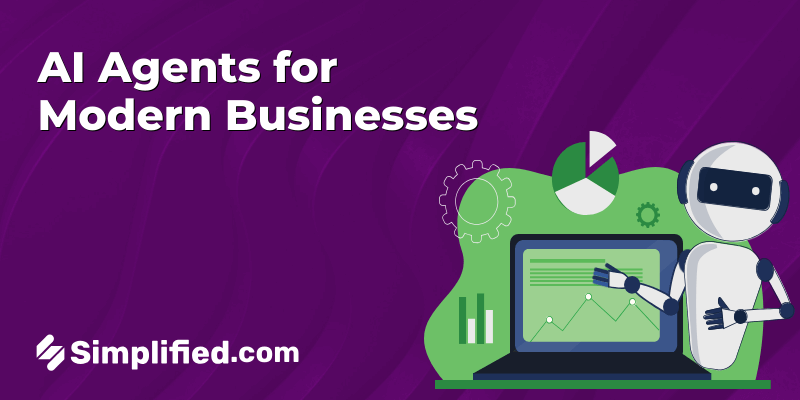
AI marketing agents are something different entirely. They don’t wait for your prompts. They plan, execute, and adapt on their own — coordinating across tools, making decisions based on your data, and actually completing tasks end-to-end. Think less “helpful chatbot” and more “junior marketing hire who never sleeps.”
The shift is happening fast. 45% of marketing teams already use at least one agentic AI system, up from just 15% in 2024. The global AI agents market is projected to hit $10.9 billion in 2026, growing at over 45% annually. And teams running agent-based workflows report 27% faster campaign build times and 19% lower cost per qualified lead.
If you’re the whole marketing team at your company — the one person doing the writing, design, posting, and reporting – this guide is aimed squarely at you. It breaks down what AI marketing agents are, how they work, five practical use cases, and how to get started without a technical background. Throughout, we’ll use Simplified’s marketing agent, Riley, as a running example of what a full-stack marketing agent actually looks like in practice: less a single bot, more the AI marketing team you couldn’t afford to hire.
What Are AI Agents for Marketing (and How Are They Different from Chatbots)?
An AI marketing agent is an autonomous AI system that takes a goal, breaks it into subtasks, connects to your marketing tools, makes decisions based on your data, and executes multi-step workflows without constant human input. Unlike chatbots that respond one prompt at a time, AI marketing agents plan, act, and adapt on their own.
Let’s clear up the confusion, because “AI agent” gets thrown around loosely.
A chatbot responds to your input. You ask a question, it answers. You give it a prompt, it generates text. It’s reactive — it only does what you ask, one step at a time.
An AI agent operates differently. It takes a goal (“publish three blog-to-social posts this week”), breaks it into subtasks, uses tools and data sources to complete each step, and makes decisions along the way. It can pull analytics from Google, draft content, check your brand guidelines, schedule posts, and flag anything that needs your approval — all without you hovering over each step. (For a deeper dive on this distinction, read our guide on AI agents vs chatbots.)
Here’s the simplest way to think about it:
- Chatbot: “Write me a social media caption about our new product launch.”
- AI agent: Checks your product page, reviews top-performing post formats in your analytics, writes three caption variations matched to your brand voice, selects the best image from your library, schedules each version for optimal posting times, and sends you a summary for approval.
The technical term is agentic AI — AI systems that can plan, reason, use tools, and take action autonomously. Industry analysts estimate that 40% of enterprise applications will embed task-specific AI agents by the end of 2026, up from less than 5% in 2025. That’s not a gradual trend. That’s a structural shift in how marketing work gets done.
Key Characteristics of AI Marketing Agents
What separates a real AI agent from a glorified chatbot? Four things:
- Autonomy: Agents complete multi-step tasks without constant human input. You set the goal; they figure out the path.
- Tool use: They connect to your existing tools — analytics platforms, CRMs, social media accounts, design editors — and take actions within them.
- Memory and context: They learn from your brand guidelines, past performance data, and preferences. They get better at your specific business over time.
- Decision-making: They evaluate options, choose approaches, and adapt based on results. A scheduling agent won’t just post at random — it’ll analyze when your audience is most active and adjust.
How AI Agents Work in a Marketing Workflow
Most AI marketing agents follow a loop: perceive, plan, act, learn. Here’s what that looks like in practice.
The Agent Workflow Loop
Perceive: The agent pulls in data from your connected tools. That might be Google Analytics traffic data, social media engagement metrics, CRM lead scores, or competitor content.
Plan: Based on that data and your goals, it creates a task list. For example: “Blog traffic dropped 15% this month. The top-performing post from last quarter hasn’t been promoted on social in 6 weeks. Create three social variations and schedule them this week.”
Act: The agent executes. It drafts content, selects visuals, schedules posts, sends emails, updates spreadsheets — whatever the workflow requires.
Learn: After execution, it reviews results. Did engagement go up? Did the email get opens? It feeds those outcomes back into future decisions.
Single Agents vs. Multi-Agent Systems
Early AI automation was one agent doing one job — writing an email, summarizing a report. That’s useful, but limited.
The real power comes from multi-agent orchestration, where multiple specialized agents collaborate. Picture this:
- A research agent monitors trending topics in your industry
- A content agent drafts blog posts and social content based on those trends
- A design agent creates matching visuals aligned with your brand kit
- A distribution agent schedules and publishes across channels
- A analytics agent tracks performance and feeds insights back to the research agent
Each agent is good at one thing. Together, they run a content operation that would normally require a team of five. Platforms like Simplified’s AI Workflow Automation let you build these multi-agent systems visually, without writing code — connecting agents through drag-and-drop workflows with 500+ integrations to tools you already use. (For a step-by-step walkthrough, see our guide on AI marketing workflows.)
That orchestration is exactly the idea behind Simplified’s marketing agent, Riley. Rather than making you wire up five separate bots, Riley coordinates research, writing, design, scheduling, and reporting inside one system that already knows your brand — then hands you the finished work to approve before anything ships. It’s the difference between renting five tools and putting one marketing agent to work: the whole job, in one place, with you still in control. Think of Riley less as a single bot and more as the AI marketing team for the one-person marketing team.
5 High-Impact Use Cases for AI Marketing Agents
Enough theory. Here are five specific ways AI agents are saving marketing teams real time and money right now, with results you can actually measure.
1. Content Repurposing at Scale
The problem: You spend four hours writing a blog post, then it sits on your website. You know you should turn it into social posts, email content, a video script, and a carousel — but who has time?
How agents solve it: A content repurposing agent takes your blog post and automatically generates:
- 5-7 social media posts (tailored per platform — LinkedIn gets a different format than Instagram)
- An email newsletter summary
- A video script or text overlay for short-form video
- Key quotes formatted as shareable graphics
- A carousel post for LinkedIn or Instagram
It does this by understanding your brand voice, analyzing which formats performed best historically, and pulling from your brand kit for visual consistency.
The result: One piece of content becomes 10-15 assets. Marketing teams using content repurposing agents report creating 3-5x more content without adding headcount. With a platform like Simplified, you can go from blog draft to scheduled social posts in a single workflow — write with AI, design visuals, and schedule across all your social channels without switching tabs.
2. Social Media Scheduling and Optimization
The problem: You’re posting when you have time, not when your audience is online. Your content calendar has more gaps than content.
How agents solve it: A social scheduling agent does more than queue posts. It:
- Analyzes your historical engagement data to find optimal posting windows
- Adjusts schedules based on real-time performance (if Tuesday 2pm posts consistently underperform, it shifts)
- Monitors for trending topics and suggests timely content
- Handles bulk scheduling — load a week or month of content in one session
- Manages first-comment strategies with hashtags for Instagram reach
The result: Teams using AI-optimized scheduling see 15-25% higher engagement rates compared to manual posting. The time savings alone are significant — what used to take 5-10 hours weekly drops to under an hour. (Compare the best social media scheduling tools to find the right fit.)
3. Ad Creative Generation and Optimization
The problem: You’re spending $500-5,000/month on ads, but your creative is stale. Testing new variations manually is slow and expensive.
How agents solve it: An ad optimization agent:
- Generates multiple ad copy and visual variations from a single brief
- Tests headlines, images, and CTAs systematically
- Monitors performance metrics (CTR, CPA, ROAS) and pauses underperformers
- Reallocates budget toward winning combinations
- Creates platform-specific variations (what works on Facebook doesn’t always work on LinkedIn)
According to McKinsey, agentic AI can accelerate campaign creation and execution by 10-15x, which means you can test ten ad variations in the time it used to take to produce one.
The result: Businesses using AI agents for ad optimization report up to 37% cost savings in marketing operations and 3-15% revenue uplift. That’s not hypothetical — it’s money back in your pocket.
4. Lead Nurturing and Follow-Up
The problem: Leads come in, but follow-up is inconsistent. Your sales team is stretched thin, and half the leads go cold before anyone reaches out.
How agents solve it: A lead nurturing agent:
- Scores incoming leads based on behavior, demographics, and engagement signals
- Triggers personalized email sequences based on where leads are in the funnel
- Routes high-intent leads to sales immediately while nurturing lower-intent ones
- Adjusts messaging based on which content the lead has consumed
- Follows up at intervals proven to maximize conversion without feeling pushy
This is where integrations matter. An effective lead nurturing agent connects your CRM (Salesforce, HubSpot, Pipedrive), email platform, website analytics, and social data into a unified view. Simplified’s no-code AI workflows connect to 500+ tools through pre-built integrations, so your agents can pull lead data from HubSpot, send personalized content created in Simplified, and update your CRM — automatically. (See our roundup of top marketing automation tools for more options.)
The result: Teams using agent-based lead nurturing report 19% lower cost per qualified lead and significantly faster response times. When a lead downloads your ebook at 11pm, the agent follows up immediately — not three days later when someone checks the inbox.
5. Marketing Reporting and Analytics
The problem: You spend hours every week pulling data from five different platforms, copying it into spreadsheets, and trying to make sense of what’s actually working.
How agents solve it: A reporting agent:
- Pulls data from all your marketing platforms automatically (social, email, ads, website, CRM)
- Creates unified dashboards with the metrics that actually matter
- Identifies trends and anomalies — “Instagram engagement dropped 20% this week, likely due to reduced posting frequency”
- Generates plain-English summaries so you don’t need to be a data analyst
- Recommends specific actions based on what the data shows
The result: Marketers using AI agents for reporting recover an average of 6.1 hours per week. Senior marketers save even more — 8-10 hours weekly. That’s a full workday back, every single week.
AI Agent Marketing Adoption: What the Numbers Say
The shift toward agentic AI marketing isn’t theoretical. Here’s where things stand right now:
- 45% of marketing teams use at least one agentic AI system in 2026, up from 15% in 2024
- 52% of senior executives say AI agents are broadly or fully adopted across their company
- 83% of marketing teams report clear ROI from generative AI tools
- $10.9 billion: projected global AI agents market in 2026
- 27% faster campaign build times for teams using agent workflows
- 37% cost savings in marketing operations reported by businesses using AI agents
- 10-30% revenue growth expected from AI-driven hyperpersonalized marketing
But here’s the honest picture: adoption doesn’t guarantee success. McKinsey found that 70-85% of AI projects failed in 2025. The difference between the teams that succeed and those that don’t? They start with specific, measurable workflows instead of trying to “AI-ify” everything at once.
How to Get Started with AI Marketing Agents (Without a Technical Background)
You don’t need to hire an AI engineer or learn Python. Here’s a practical roadmap for getting your first AI marketing agent running this week.
Step 1: Pick One Workflow That’s Eating Your Time
Don’t try to automate everything on day one. That’s how most AI projects fail.
Instead, pick the one marketing task that’s most repetitive and time-consuming. Good candidates:
- Turning blog posts into social media content (content repurposing)
- Weekly performance reporting
- Scheduling social posts across multiple platforms
- Following up with new leads
- Generating ad creative variations
Pick the one that makes you groan every week. That’s your starting point.
Step 2: Choose a Platform That Doesn’t Require Coding
The best AI agent platforms for marketing teams are visual and no-code. You should be able to build a workflow by dragging and dropping steps, not writing scripts.
Look for these features:
- Visual workflow builder: See your agent’s logic as a flowchart, not a code file
- Pre-built templates: Start with a working workflow and customize, rather than building from scratch
- Integrations with your existing tools: Your agents need to connect to your CRM, social accounts, email platform, and analytics
- Human-in-the-loop controls: The ability to add approval steps where you want them. Full autonomy sounds good in theory, but in practice you want to review content before it goes live
- Brand knowledge base: A place to store your brand voice, guidelines, and assets so agents stay on-brand
Simplified’s AI Workflow Automation checks all of these boxes. The visual builder lets you design multi-agent workflows with drag-and-drop, connect to 500+ tools (Notion, Slack, HubSpot, Salesforce, WordPress, Shopify), and add human approval steps anywhere in the chain. You can set up a content repurposing workflow in under 30 minutes — no technical background needed. And if you’d rather not build the workflow at all, Simplified’s marketing agent, Riley, ships with these marketing workflows ready to run: you brief it, it does the work, and you approve before anything goes live.
Step 3: Set Up Your Brand Knowledge Base
This is the step most people skip, and it’s why their AI output sounds generic.
Before you launch any agent, feed it your brand context:
- Brand voice guidelines (tone, vocabulary, messaging pillars)
- Visual brand standards (colors, fonts, logo usage)
- Top-performing content examples
- Product information and key differentiators
- Audience personas and pain points
With Simplified, you store this in your Brand Kit and Knowledge Base. Every agent in your workflow draws from this context, so whether it’s writing a social caption or generating ad copy, the output sounds like your brand — not like generic AI.
Step 4: Start Small, Then Expand
Run your first agent workflow for two weeks. Measure the results:
- How much time did you save?
- Was the output quality acceptable? (Be honest — did it need heavy editing, light editing, or none?)
- Did it catch anything you would have missed?
- Where did it need human intervention?
Based on those answers, refine the workflow. Adjust the prompts, add or remove approval steps, and tighten the brand guidelines. Then and only then add your next agent workflow.
The teams seeing 27% faster campaign builds and 37% cost savings didn’t get there overnight. They started with one workflow, got it right, and scaled from there.
What AI Marketing Agents Can’t Do (Yet)
Let’s be straight about the limitations, because overpromising is how tools lose trust.
AI agents in 2026 are not a replacement for marketing strategy. They execute brilliantly within defined parameters, but they can’t:
- Develop your brand positioning from scratch: They can maintain voice consistency, but the strategic decisions about who you are and what you stand for are still human work.
- Understand cultural nuance perfectly: An agent might miss that a trending topic is sensitive in certain markets, or that a particular phrase carries unintended meaning.
- Build genuine relationships: Networking, partnership development, and community building require human connection.
- Replace strategic judgment: Agents can surface data and recommend actions, but deciding which market to enter or which product to launch still needs a human at the wheel.
The best approach is human-in-the-loop: agents handle the heavy lifting of execution, data analysis, and content production, while humans provide strategic direction, quality review, and relationship management. This isn’t a compromise —it’s the configuration that actually delivers the best results.
The Future of AI Agents in Marketing
Where is all this heading? Based on current trajectories and industry analysis, here’s what’s coming:
More specialized agents, not bigger ones. The trend isn’t toward one giant AI that does everything. It’s toward small, focused agents that are experts at specific tasks — and that collaborate through orchestration layers. A writing agent, a design agent, a scheduling agent, an analytics agent, all coordinating seamlessly.
Voice and video agents. Most current agents work with text. The next wave will handle video creation, voice content, and multimodal campaigns natively. You’ll describe a campaign concept in plain English, and agents will produce the blog post, the social video, the ad creative, and the email — all coordinated.
Agents that learn your specific business. Today’s agents get brand guidelines. Tomorrow’s will deeply understand your customer segments, seasonal patterns, competitive landscape, and what’s worked in the past. They’ll proactively suggest campaigns based on emerging opportunities in your data.
Democratized access. Right now, sophisticated agent systems still require some setup. But no-code visual builders are closing the gap fast. The small business owner who can’t afford a marketing team will have access to AI agent capabilities that rival what enterprise teams built just two years ago.
Put an AI Marketing Agent to Work This Week
Here’s what this all comes down to: AI agents for marketing aren’t a future trend. They’re a present reality that 45% of marketing teams are already using. The early adopters aren’t just saving time — they’re seeing 27% faster campaigns, 37% lower costs, and measurably better results.
You don’t need a big budget or a technical team to get started. You need one repetitive workflow, a platform with visual agent building, and 30 minutes to set it up.
That’s what Simplified’s marketing agent, Riley, is built to be: not another tool to learn, but an AI marketing agent that plans the campaign, writes the copy, designs the visuals, makes the video, and schedules the posts across every channel — all from one brand kit, and always with your approval before anything publishes. Made and posted, on your brand. It’s the AI marketing team for the one-person marketing team.