By KD Deshpande

Last March, a three-person marketing team at a SaaS startup was spending 47 hours per week on campaign execution. Writing emails. Scheduling posts. Adjusting ad bids. Pulling analytics reports. Reformatting content for different channels. Twelve months later, the same team runs twice the campaigns in half the time, because they deployed AI agents to handle the repetitive 80%.
This isn’t science fiction. It’s the reality of marketing in 2026. And picking from the best AI marketing agents is now less about who writes the slickest caption and more about how much of the job a tool can actually carry end to end.
AI agents are fundamentally different from the chatbots and content generators that dominated 2024. Those tools waited for instructions. AI agents take action. They reason through problems, coordinate across your tool stack, make decisions within guardrails you set, and follow through until the job is done.
The numbers back it up: multi-agent systems outperform single-agent approaches by 90.2% on complex tasks. Marketing teams using AI agents report 73% faster campaign development and 68% shorter content creation timelines. By 2028, Gartner predicts 33% of organizations will use agentic AI.
But not every “AI agent” lives up to the label. Some are rebranded chatbots. Some work brilliantly in demo videos and fall apart with real data. This guide covers nine AI marketing agents that actually deliver, what they do, what they cost, and which ones match your team size and tech stack.
What Makes AI Agents Different from AI Tools
Before comparing platforms, the distinction matters.
AI tools (ChatGPT, Jasper, most “AI features” in SaaS products) generate output when you ask. You write a prompt, you get a result. The tool waits for your next instruction.
AI agents operate autonomously within boundaries. You define the goal (“optimize our email campaign for higher open rates”) and the guardrails (“stay within brand guidelines, don’t exceed $500/day spend”). The agent decides what steps to take, uses your existing tools, monitors results, and adjusts its approach without waiting for you to intervene.
The practical difference: an AI tool writes your email subject line. An AI agent writes the subject line, segments your audience, schedules sends at optimal times, monitors open rates, tests variations, and shifts budget toward what’s working. All while you focus on strategy.
The sharper way to compare the tools below is by how much of the job each one carries. A marketing job has three parts: planning (what to say and where), creating (design, video, copy at brand quality), and publishing (getting it live across channels). Most tools own one slice. A few try to own more. That lens is how we ranked this list.
Want to see AI handle your content workflow? Try Simplified’s AI tools free and automate writing, design, and scheduling from one platform.
The 9 Best AI Marketing Agents for 2026
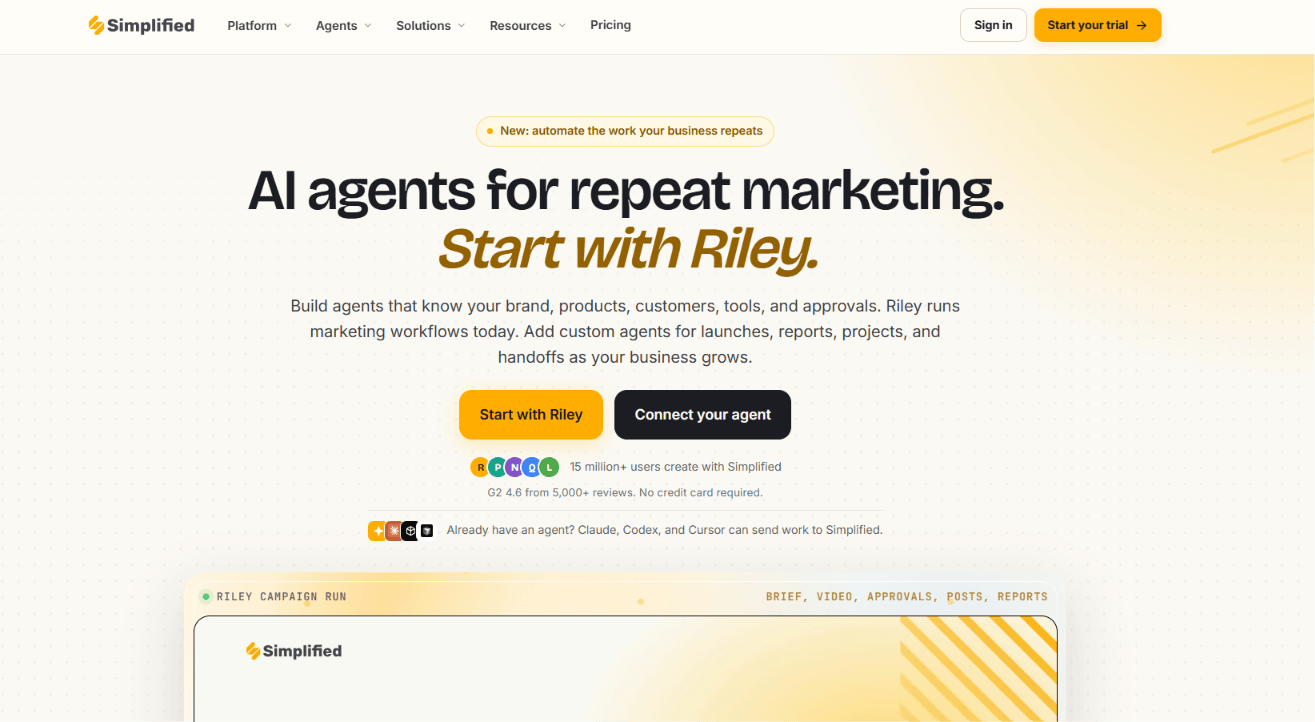
1. Simplified’s Marketing Agent, Riley: Best for Owning the Whole Job, Governed
Price: $20/month (annual) | Free tier available
Best for: Solo marketers and small teams who need to plan, create, and publish without stitching five tools together
Most tools on this list do one slice of the work. Simplified’s AI marketing agent, Riley, is built to carry the whole job: it plans the campaign, creates the assets at brand quality (design, video, and copy, not just text), and publishes across your channels, with a human approval step before anything goes live. Riley isn’t framed as an autonomous bot working around you. It’s the AI marketing team for the one-person marketing team, the layer that turns a brief into finished, on-brand, scheduled work while you stay in the approver’s seat.
What sets it apart: Coverage plus control. An “AI CMO” tool can strategize but hands you a plan you still have to execute. A generator can make a graphic but can’t schedule it. A scheduler can post but can’t create. Simplified’s marketing agent, Riley, connects planning, creation, and publishing in one place, then holds each step for your review. For a small team, that’s the difference between “AI that gives me more to do” and “AI that gives me finished work to approve.”
Tom runs a local bakery with an active Instagram and Facebook presence. He used to spend Sunday evenings writing the week’s posts, designing graphics in one tool, and scheduling in another. Now he briefs Simplified’s marketing agent, Riley, once: it drafts the week’s captions in his voice, designs matching graphics, and queues every post for him to approve in a single pass. His Sunday task went from two hours to 25 minutes, and he still signs off on everything before it publishes.
The honest trade-off: Simplified’s AI marketing agent, Riley, is built for planning, creation, and cross-channel publishing at small-to-mid scale. It doesn’t run the deep, CRM-wired campaign logic of an enterprise platform like Agentforce or the round-the-clock bid optimization of a dedicated ad tool like Albert AI. If your core need is six-figure paid-media management or enterprise CRM orchestration, pair Riley with a specialist. For teams who need the whole content job done and shipped, it’s the most complete option here.
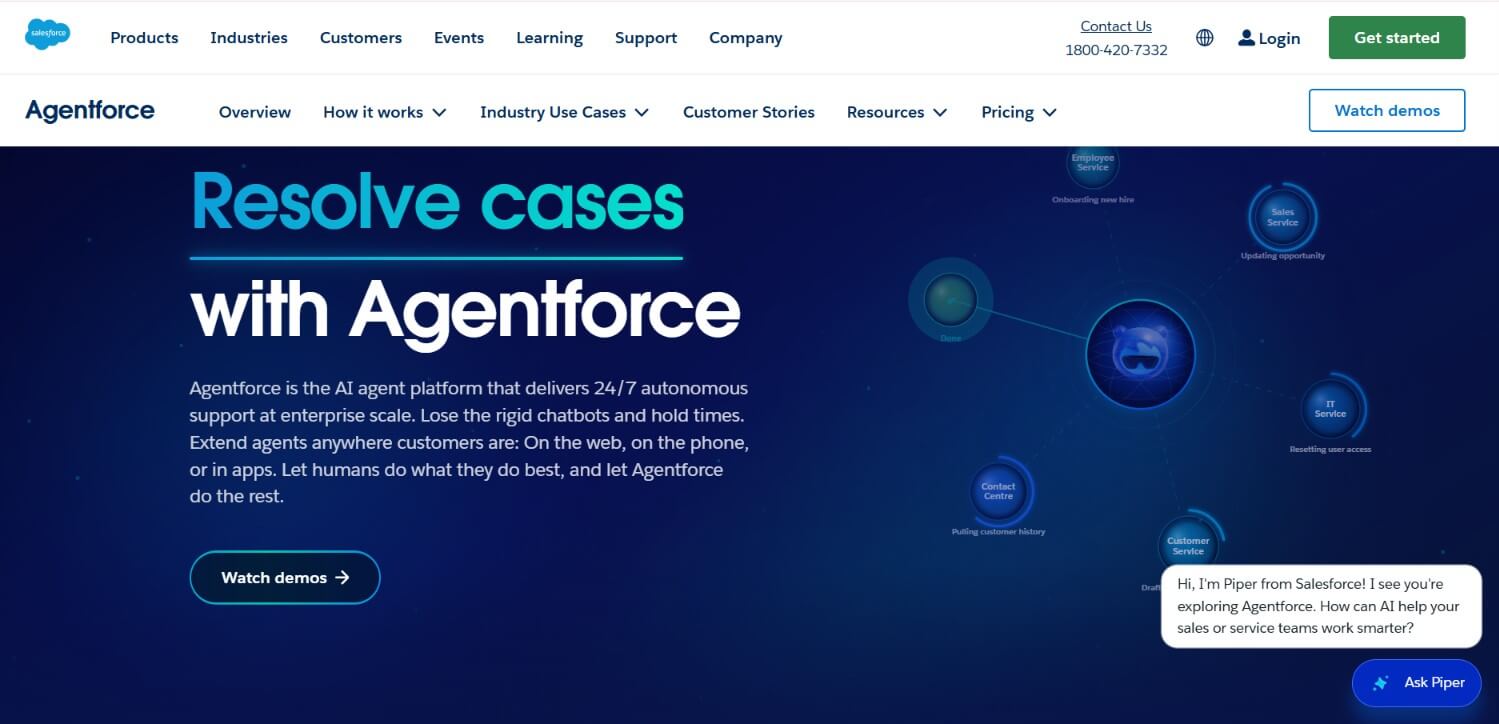
2. Salesforce Agentforce: Best for Enterprise CRM-Driven Marketing
Price: Enterprise pricing (contact Salesforce)
Best for: Large marketing teams deeply embedded in the Salesforce ecosystem
Salesforce Agentforce isn’t a bolt-on feature. It’s an autonomous layer built directly into the Salesforce platform. The agents create campaign briefs, generate audience segments, develop personalization strategies, and execute cross-channel campaigns, all pulling from your CRM data in real time.
What sets it apart: The depth of CRM integration. Agentforce doesn’t just access your customer data; it reasons about it. The agent can identify that customers in segment X responded 40% better to email series Y, then autonomously adjust your next campaign to reflect that insight.
The honest trade-off: You need Salesforce. If your marketing stack runs on HubSpot, Mailchimp, or independent tools, Agentforce isn’t accessible. It’s also enterprise-priced, making it impractical for teams under 50 people.
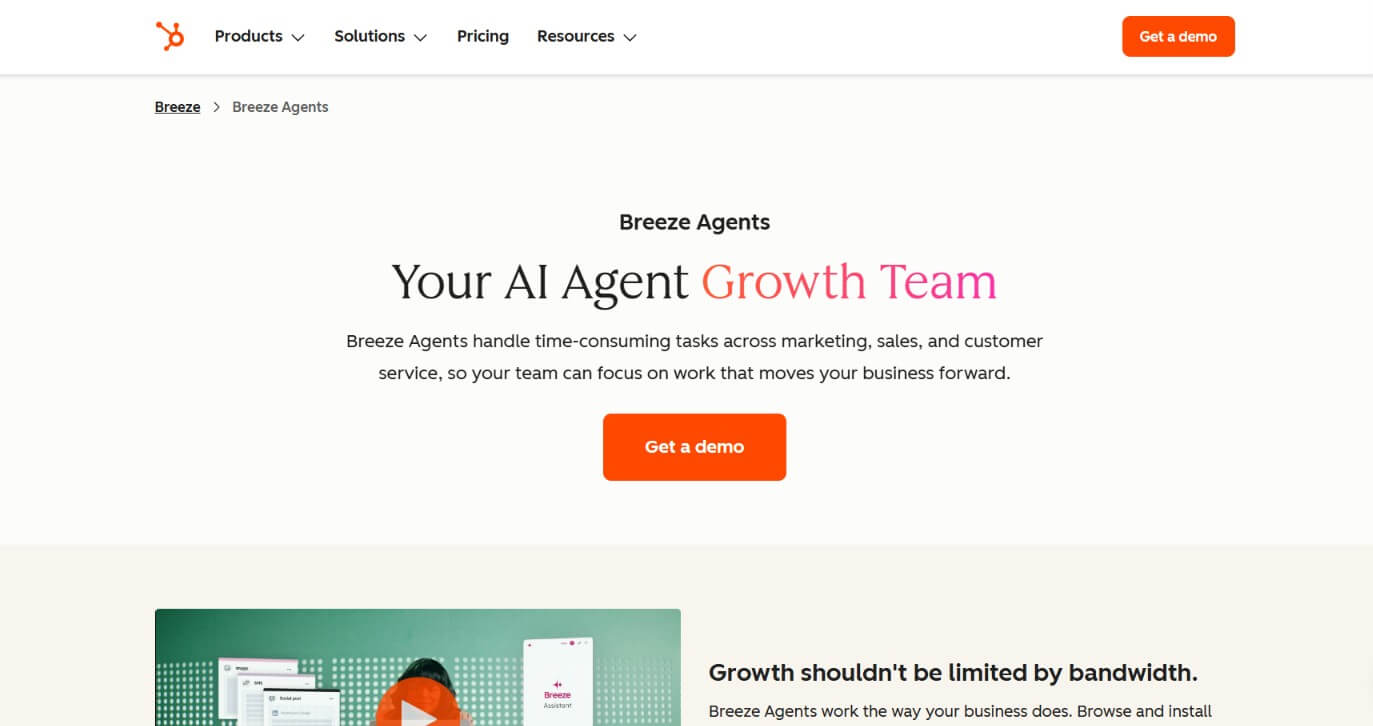
3. HubSpot Breeze AI: Best All-in-One Marketing Agent
Price: Included with HubSpot subscriptions (varies by tier)
Best for: Small to mid-sized businesses using HubSpot for marketing, sales, and CRM
HubSpot’s Breeze AI deploys specialized agents for different functions: a Prospecting Agent for lead generation, a Content Agent for writing, and a Social Media Agent for scheduling and engagement. They share data and coordinate actions across the HubSpot platform.
Rachel runs marketing for a 20-person B2B company. Before Breeze, her team spent Monday mornings pulling last week’s campaign data, Tuesday writing new email sequences, and Wednesday scheduling social content. After deploying Breeze agents, the data pulls happen automatically overnight. The Content Agent drafts email sequences based on what performed well. The Social Media Agent queues posts aligned with the email campaign themes. Rachel’s team now spends those three days on strategy and creative work instead of execution.
Where Breeze falls short: Like Agentforce, you need HubSpot. The agents operate within HubSpot’s ecosystem. If your email runs on ActiveCampaign and your CRM lives in Salesforce, Breeze can’t orchestrate across those boundaries.
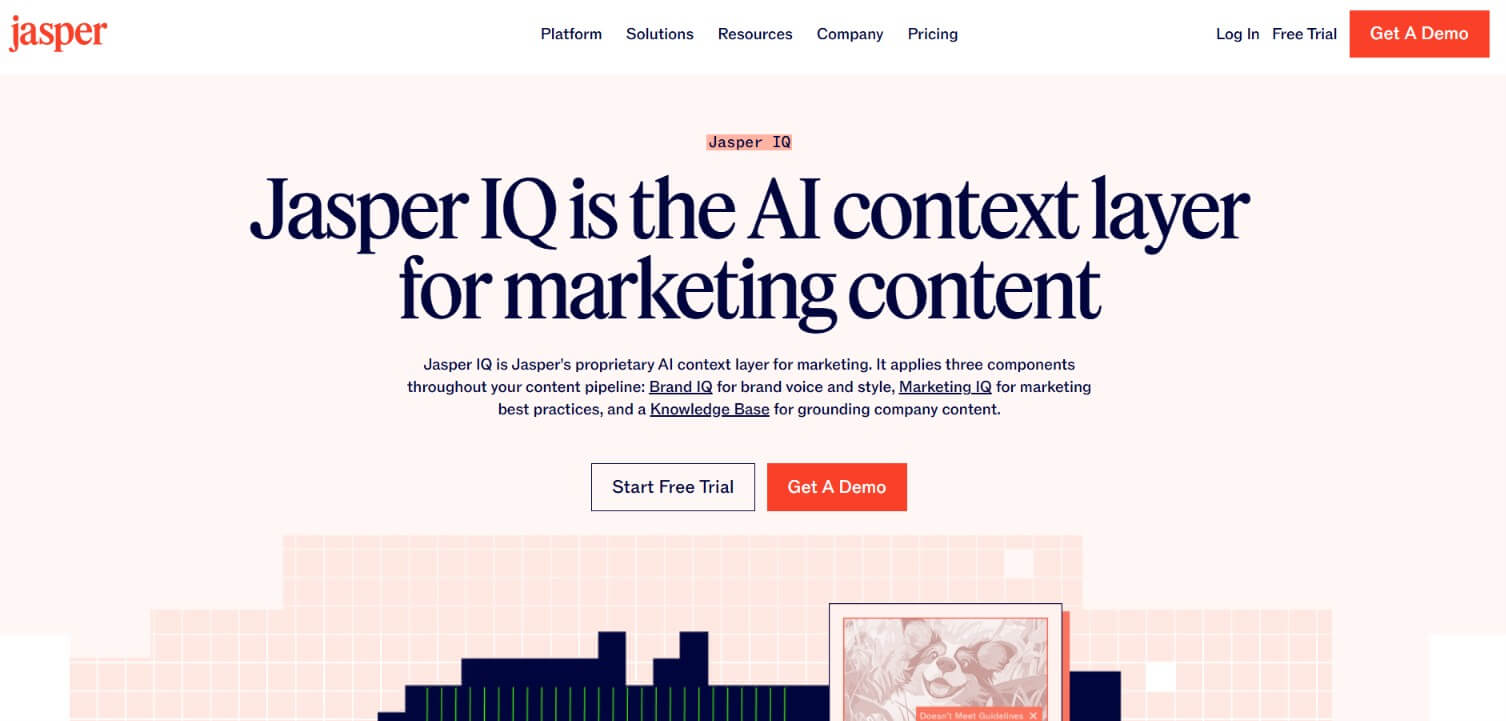
4. Jasper with Jasper IQ: Best for Brand-Consistent Content at Scale
Price: Starting $39/month | Enterprise pricing available
Best for: Content-heavy organizations that need brand voice consistency across every channel
Jasper evolved from an AI writing tool into a content agent with “Jasper IQ,” a system that absorbs your entire brand knowledge base. Feed it your style guides, past campaign performance data, customer personas, and brand guidelines. Every piece of content the agent produces reflects your brand, not generic AI output.
What makes it different: Most AI writing tools learn your tone. Jasper IQ learns your strategy. It understands which messaging angles drove conversions last quarter, which topics resonate with specific segments, and which formats perform best on each channel. Then it applies that intelligence to every new piece of content.
The limitation: Jasper excels at content creation but doesn’t handle campaign orchestration, ad optimization, or scheduling. You’ll still need separate tools for the rest of your marketing workflow.
5. Copy.ai GTM Operating System: Best for Go-to-Market Workflows
Price: Mid-tier pricing | Enterprise options available
Best for: Sales and marketing teams that need end-to-end go-to-market automation
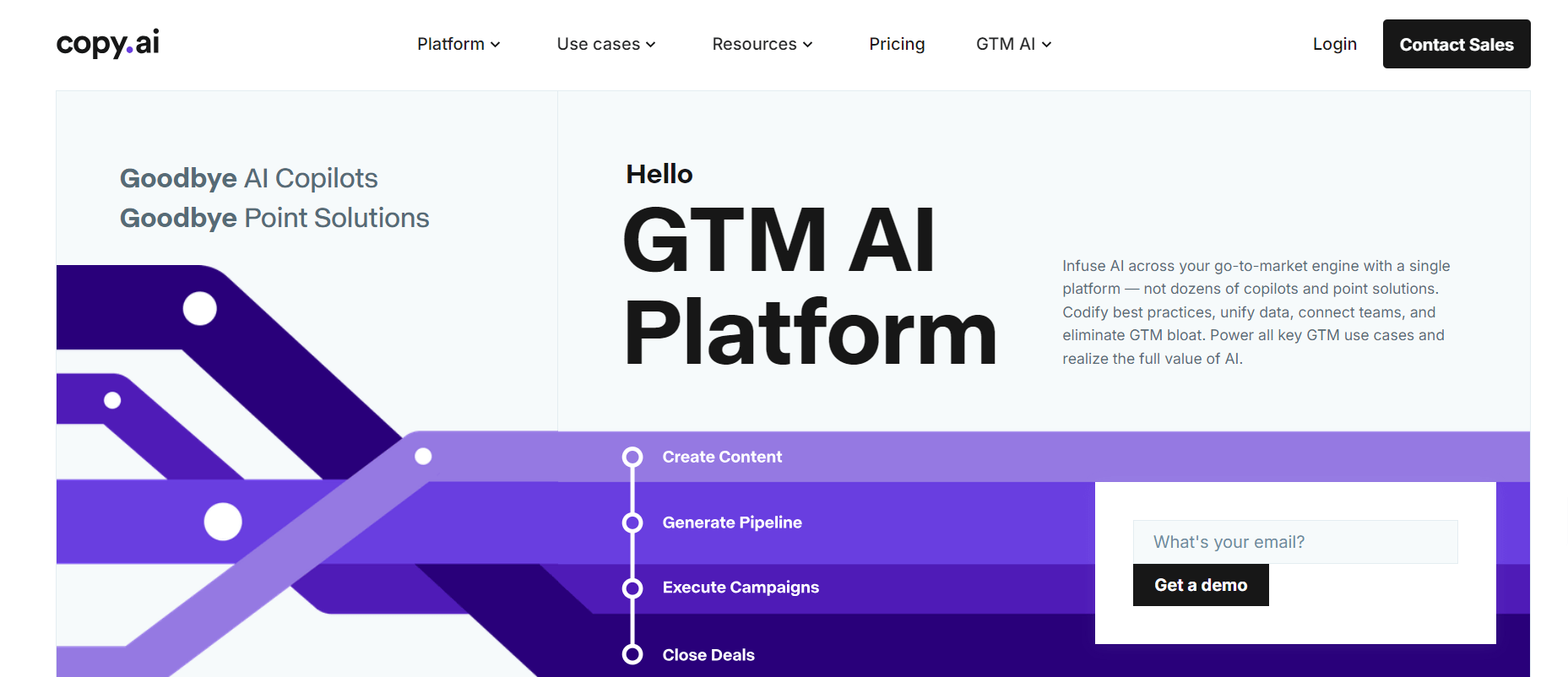
Copy.ai has evolved far beyond its origins as a copywriting tool. The “GTM Operating System” uses “Circuits,” multi-step workflow automations that handle lead qualification, personalized outreach, content generation, and follow-up sequences autonomously.
The practical application: A Circuit can take a new inbound lead, research their company, qualify them against your ICP criteria, generate a personalized outreach email, send it at the optimal time, and route them to the right sales rep. That workflow used to require a marketing ops person, a BDR, and 48 hours. A Circuit does it in minutes.
The gap: Copy.ai’s strength is go-to-market workflows, specifically the handoff between marketing and sales. If your primary need is social media management, creative design, or paid advertising, other agents handle those better.
6. Albert AI: Best for Autonomous Paid Advertising
Price: Enterprise pricing (performance-based options)
Best for: Performance marketing teams running significant ad spend across multiple channels
Albert AI operates 24/7 without human approval. It adjusts bids in real time, reallocates budget toward high-performing campaigns, tests creative variations, and optimizes targeting, all autonomously. While your team sleeps, Albert is shifting $200 from an underperforming Facebook ad set to a Google campaign that’s converting 3x better.
Where Albert shines: Teams spending $50,000+ per month on paid advertising see the biggest impact. At that spend level, the difference between human-speed optimization (checking campaigns twice daily) and AI-speed optimization (adjusting every 15 minutes) translates to thousands of dollars in recovered ad spend.
The trade-off: Albert is expensive and focused entirely on paid channels. It doesn’t write content, manage social media, or handle email campaigns. For teams with smaller ad budgets, the ROI math doesn’t work.
7. ActiveCampaign AI Agents: Best for Email Marketing Automation
Price: Included with ActiveCampaign plans (varies by tier)
Best for: E-commerce and B2B teams that rely heavily on email marketing
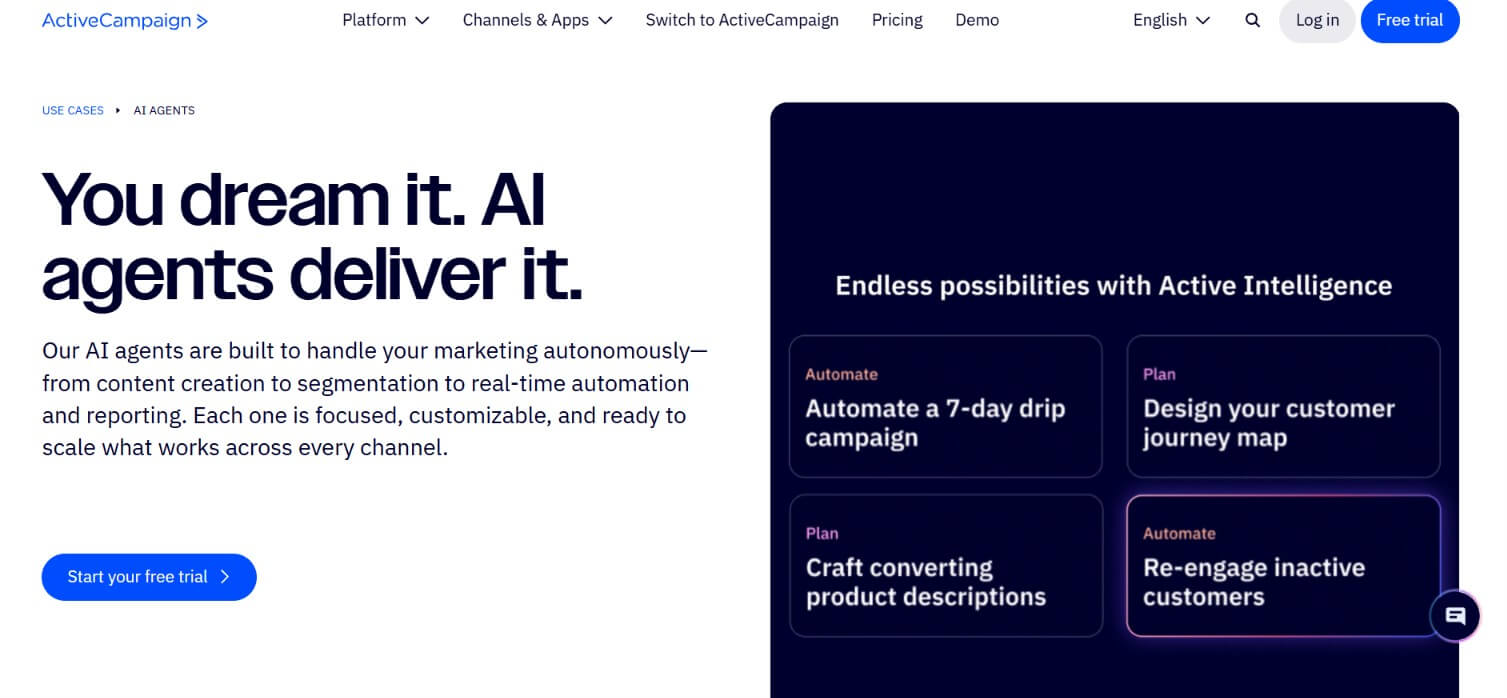
ActiveCampaign’s AI agents specialize in what matters most for email: timing. The agents analyze individual subscriber behavior patterns and send messages at the exact moment each person is most likely to open and click. Not “Tuesdays at 10am” for everyone. Personalized send times for every subscriber.
The impact is measurable. Teams using ActiveCampaign’s AI timing optimization report 15-25% higher open rates and 10-20% higher click-through rates compared to scheduled batch sends.
The limitation: ActiveCampaign agents are email-first. They handle behavioral segmentation, send time optimization, and email workflow automation extremely well. For social media, paid ads, or content creation, you’ll need to pair them with other tools.
8. Gumloop: Best No-Code Agent Builder
Price: Usage-based pricing
Best for: Non-technical marketers who want to build custom AI workflows
Gumloop lets you build continuous AI agents without writing code. Define triggers (“when a new blog post is published”), actions (“generate five social posts, create an email teaser, update the content calendar”), and conditions (“if engagement on LinkedIn exceeds 2%, boost the post budget”). The agent runs automatically on new data.
What makes it valuable: The customization. Pre-built agents solve common problems. Gumloop lets you build agents for your specific workflow, however unusual it might be.
The trade-off: You’re building, not buying. Gumloop provides the platform, but the quality of your agents depends on how well you design them. Teams without clear workflow definitions will struggle.
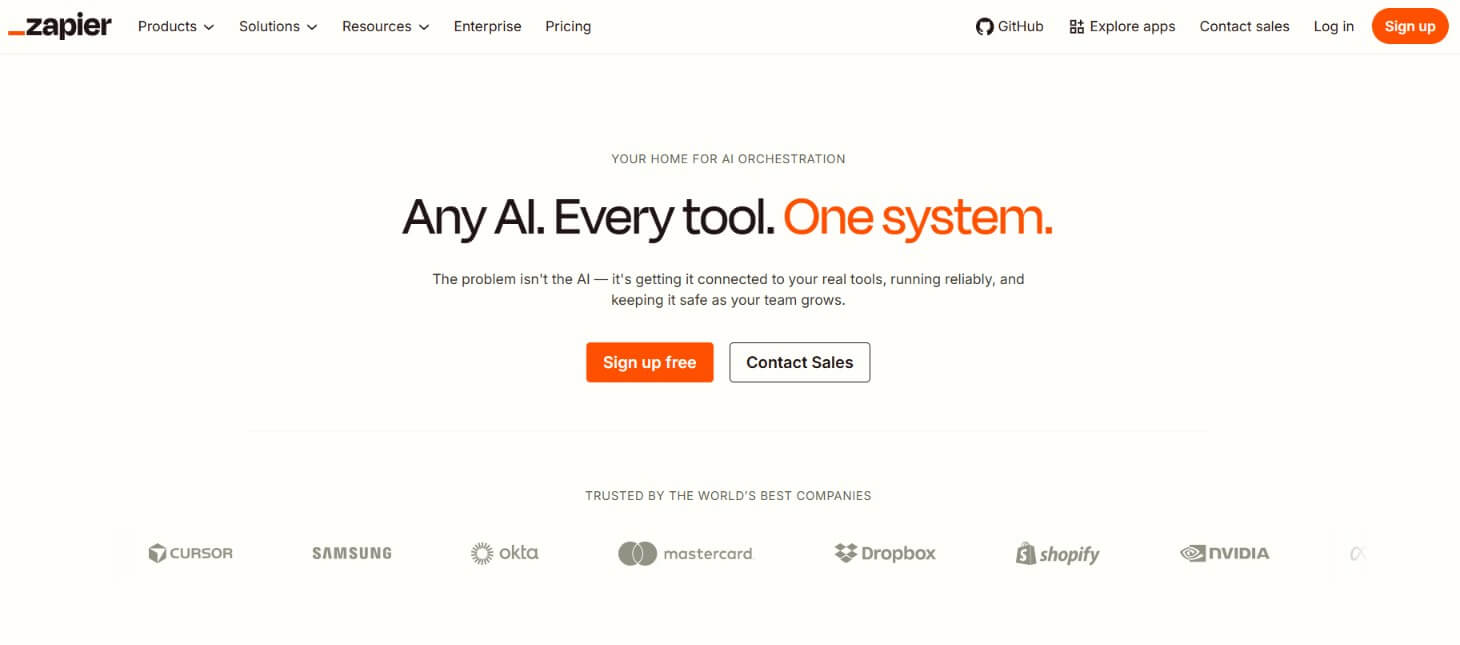
9. Zapier with AI Features: Best for Cross-Platform Coordination
Price: Free tier available | Paid plans based on tasks/month
Best for: Marketing teams using multiple tools that need to communicate
Zapier connects thousands of apps and adds an AI layer to those connections. It’s not an AI agent in the autonomous sense, but it orchestrates workflows across your entire tool stack. When a lead fills out a form in Typeform, Zapier can add them to HubSpot, trigger an email sequence in ActiveCampaign, create a task in Asana, and notify the sales team in Slack.
When Zapier makes sense: If your marketing stack is fragmented across 5-10 tools and you need them to work together, Zapier is the coordination layer. It doesn’t replace specialized agents; it connects them.
The limitation: Zapier automates predefined workflows. It doesn’t reason about problems or adapt to changing conditions the way true AI agents do.
How to Choose the Right AI Marketing Agent
By team size:
Solo creators and small businesses (1-5 people): Simplified’s marketing agent, Riley ($20/month) to plan, create, and publish content across channels. ActiveCampaign for email automation. Zapier to connect your tools.
Growing teams (5-20 people): HubSpot Breeze for all-in-one marketing automation. Copy.ai for go-to-market workflows. Jasper for brand-consistent content at scale.
Enterprise (20+ people): Salesforce Agentforce for CRM-driven campaigns. Albert AI for paid advertising optimization. Jasper IQ for enterprise content operations.
By marketing channel:
| Channel | Best Agent | Why |
|---|---|---|
| Content creation | Jasper IQ, Simplified | Brand voice + multi-format |
| Email marketing | ActiveCampaign | Send time optimization |
| Paid advertising | Albert AI | 24/7 autonomous optimization |
| Social media | HubSpot Breeze, Simplified | Scheduling + AI content |
| Lead generation | Copy.ai | GTM workflow automation |
| Campaign orchestration | Salesforce Agentforce | CRM-integrated execution |
| Custom workflows | Gumloop | No-code agent building |
Ready to automate your content workflow? Start with Simplified. AI writing, design, and scheduling in one platform. No credit card required.
Getting Started: A Practical Framework
Step 1: Audit your time
Track where your marketing hours go for one week. Most teams discover that 60-70% of their time goes to execution (writing, scheduling, reporting, formatting) and only 30-40% to strategy and creative thinking.
Step 2: Pick your highest-impact automation
Don’t automate everything at once. Choose the single workflow that consumes the most time with the most predictable steps. For most teams, that’s either content creation, email sequences, or social scheduling.
Step 3: Start with guardrails
Set clear boundaries for your AI agents. What can they publish without approval? What requires human review? What’s the maximum budget they can adjust? Start narrow and expand as you build confidence.
Step 4: Measure before and after
Track the metrics that matter: time per campaign, content output volume, engagement rates, conversion rates, and team satisfaction. If the agent isn’t moving those numbers after 30 days, adjust or switch.
Step 5: Scale gradually
Once one workflow is running smoothly, add the next. Most organizations reach full agent adoption over 3-6 months, not overnight.
Frequently Asked Questions
Are AI marketing agents safe to use?
Yes, with proper guardrails. Every agent on this list includes approval workflows, budget limits, and brand guidelines enforcement. Start with narrow permissions and expand as you build trust in the system.
How much do AI marketing agents cost?
Ranges widely. Simplified starts at $20/month for content AI. ActiveCampaign includes agents in its email plans. Enterprise agents like Salesforce Agentforce and Albert AI run $5,000-50,000+/month depending on scale.
Will AI agents replace marketing teams?
No. AI agents handle execution. Strategy, creative thinking, brand storytelling, and customer empathy remain human strengths. The teams benefiting most use AI to eliminate repetitive work so humans can focus on high-value activities.
How long until AI agents show ROI?
Most teams report measurable time savings within the first month. Performance improvements (higher conversion rates, better engagement) typically appear within 3-6 months as agents learn from your data.
Can small businesses use AI marketing agents?
Absolutely. Tools like Simplified ($20/month) and ActiveCampaign provide AI agent capabilities at small business prices. You don’t need enterprise budgets to automate your content and email workflows.
The Bottom Line
AI marketing agents in 2026 aren’t a nice-to-have. They’re the dividing line between teams that scale and teams that stay stuck in execution mode.
For enterprise teams with established CRM systems, Salesforce Agentforce and Albert AI offer the deepest autonomous capabilities. For growing teams, HubSpot Breeze and Copy.ai provide strong all-in-one automation. And for small businesses and creators who need the whole content job planned, created, and published in one place, with a human approving each step, Simplified’s marketing agent, Riley, is the most complete pick at a price that makes sense.
The best approach? Start with one workflow. Pick the agent that fits your stack and budget. Automate the repetitive work. Then reinvest that time in the strategy and creativity that no AI can replace.