By
By 
Let me be honest with you—great marketing today isn’t about having the biggest budget or the loudest message. In 2025–2026, the campaigns that actually stick are the ones that feel… intentional. Thought through. A little risky, even.
People aren’t paying attention to ads like before. You skip them, I skip them—everyone does. It’s not that audiences don’t care, they just don’t care about obvious marketing anymore.
What actually gets noticed now feels different.
It looks like entertainment.
It feels like something you’d share with a friend.
Sometimes, it doesn’t even look like marketing at all.
I’ve seen campaigns built on the most unexpected ideas—a skincare brand sparked by a random name coincidence, a beer company launching a phone just to get people talking, even AI experiences that feel more like creative partners than tools.
None of these follow the old playbook.
They don’t start with “buy this.”
They start with curiosity, emotion, or surprise.
And that’s exactly why they work.
If you’re a marketer, founder, or running campaigns for clients, you don’t need more theory right now. You need real examples that show what’s actually breaking through.
That’s what this list is about.
These 20 campaigns don’t share an industry, a format, or even a common strategy. But they do share one thing that matters more than ever: they made people feel something first.
The sale came later.
What Makes a Marketing Campaign Truly Innovative in 2025–2026?
If you look closely at the campaigns that actually worked recently, you’ll notice something—they’re not random strokes of creativity. There’s a pattern behind them.
I like to think of it as four simple pillars.
Pillar 1 — Emotion Meets Strategy
The best campaigns don’t just make people feel something—they know why they’re doing it.
It could be joy, pride, or even surprise. But it’s always tied to a clear goal. Think about Dove Real Beauty or Nike So Win—they connected emotionally first, but every piece still moved the brand forward.
Pillar 2 — Cultural Relevance
Great campaigns don’t interrupt culture—they step right into it.
They use memes, trends, and the language people are already speaking. That’s why things like Wendy’s Twitter or Duolingo Death stunt feel natural instead of forced.
Pillar 3 — Tech With Purpose
There’s a lot of tech available right now—AI, personalization, automation. But the smartest campaigns don’t show it off.
They use it quietly, to improve the experience. Spotify Wrapped and Netflix recommendations work because the tech stays in the background, while the experience feels personal.
Pillar 4 — Engineered Sharing
The strongest campaigns are built to spread.
They give people a reason to participate—whether it’s creating content, using a hashtag, or sharing something that feels like theirs. Campaigns like Apple Shot on iPhone and Coca-Cola Share a Coke didn’t rely on reach—they relied on people.
“In 2025–2026, the most innovative campaigns don’t just communicate a message — they invite people to become part of it.”
Now let’s break down the 20 campaigns that nailed every one of these pillars.
20 Recent Innovative Marketing Campaign Examples That Won
1. Lamborghini — Driven by Dreams (2026)
This campaign is a perfect example of selling a feeling, not a product.
In January 2026, Lamborghini launched Driven by Dreams—a cinematic brand film that completely avoided the usual car advertising formula. No specs. No speed shots. Not even “buy now” messaging.
Instead, it focused on something much deeper: childhood imagination.
The film is built around children describing what they want to become—astronauts, magicians, inventors—while Lamborghini cars visually transform and evolve alongside those dreams. The narrative connects past, present, and future, showing how the brand has lived in people’s minds long before they could ever afford one.
You know that poster-on-the-wall moment? That’s the insight.
Strategically, this campaign works on a completely different layer:
- Emotion over product: No features, just aspiration
- Generational storytelling: From childhood dreams to adult achievement
- Brand as a symbol: Lamborghini becomes a metaphor for ambition, not just a car
It’s also positioned as a brand manifesto, reinforcing that Lamborghini isn’t just building vehicles—it’s fueling imagination and ambition across generations.
Why it worked:
It tapped into something universal. Almost everyone has dreamed of a Lamborghini at some point—even if they never buy one.
Innovation type:
Emotional Brand Storytelling + Cultural Symbol Positioning
Key takeaway:
You don’t always need to sell the product. Sometimes, owning a place in people’s dreams is more powerful than owning a place in their cart.
2. Astronomer x Gwyneth Paltrow — Crisis Comeback Campaign
This campaign is one of the clearest examples of turning a PR disaster into a marketing win—almost in real time.
In 2025, data company Astronomer was suddenly in the spotlight for the wrong reason. A viral “kiss cam” moment at a Coldplay concert exposed two senior executives, leading to resignations and widespread media attention.
Most companies would go silent or issue a formal statement.
Astronomer did the opposite.
They released a satirical video featuring Gwyneth Paltrow as a “temporary spokesperson.” The casting itself was the hook—Paltrow is the ex-wife of Coldplay’s lead singer, directly tying back to the origin of the scandal.
In the video, she addresses the situation with subtle humor while casually explaining the company’s actual product—data workflows and AI pipelines. The tone was carefully balanced: self-aware, but not insensitive.
Strategically, this campaign worked because:
- It didn’t avoid the crisis—it reframed it
- Casting created instant cultural relevance
- Humor was controlled, not reckless
Instead of losing control of the narrative, Astronomer redirected it. What started as negative attention became curiosity about the company itself.
Why it worked:
It acknowledged the moment without over-explaining it—and used storytelling to shift focus.
Innovation type:
Crisis Marketing + Cultural Casting + Earned Media Strategy
Key takeaway:
You can’t always control the situation—but you can control the narrative. If handled carefully, even a crisis can become your most powerful awareness driver.
3. KFC x Stranger Things 5 — Hawkins Fried Chicken
This campaign is a strong example of trend participation done with control—not just jumping in for visibility.
As anticipation built around Stranger Things Season 5, KFC aligned itself with the cultural moment by introducing “Hawkins Fried Chicken,” a concept that blended seamlessly into the show’s universe.
What makes this interesting is that KFC didn’t just reference the show—they adapted their branding, visuals, and storytelling to match its tone. The campaign felt like an extension of the Stranger Things world rather than a brand trying to borrow attention.
At the same time, they didn’t lose sight of their core product. The food remained central, and the messaging still reinforced what KFC is known for.
Strategically, this campaign balanced two key elements:
- Cultural timing: Launching when audience attention was already at its peak
- Brand clarity: Ensuring the product didn’t get overshadowed by the collaboration
Why it worked:
It used an existing wave of attention instead of trying to create one from scratch—but did so without diluting the brand.
Key takeaway:
You don’t need to avoid trends—you need to enter them with intention. Stay relevant to the moment, but make sure your product still has a clear role in the story.
Bonus: 100+ New Gen Z Slang Words: Meanings and How to Use Them (2026)
4. Duolingo — Death of Duo
This campaign is a clear example of what happens when a brand fully understands its internet persona—and isn’t afraid to push it further.
Duolingo has spent years building a slightly chaotic, meme-heavy presence on platforms like TikTok and X. So when they decided to “kill off” their mascot Duo, it didn’t feel random—it felt like a natural escalation of their tone.
The execution was simple but effective. The brand announced Duo’s “death” across social channels, creating a storyline that people could react to. Almost immediately, users, creators, and even other brands joined in—posting tributes, jokes, and theories.
What’s important here is that the campaign didn’t rely on high production. It relied on existing audience attachment. People already had a connection (even a playful one) with the mascot, which made the stunt land emotionally—even if the emotion was humor.
Strategically, this worked on three levels:
- Brand consistency: The humor and tone matched everything Duolingo had done before
- Audience psychology: It tapped into parasocial relationships people had with the mascot
- Platform fit: Designed for fast, reactive, social-first engagement
Why it worked:
It didn’t try to be universally safe. It stayed true to its voice—even if that meant being slightly controversial.
Key takeaway:
If your brand has a strong personality, lean into it. Playing it safe often gets ignored, but a bold move—when it fits your voice—can drive massive attention.
5. OpenAI — ChatGPT Everyday Moments
This campaign marked an important shift—not just for OpenAI, but for how AI is introduced to everyday users.
Instead of focusing on what ChatGPT can do in theory, the campaign showed how it fits into real life. Cooking dinner with limited ingredients. Planning a last-minute trip. Drafting a quick work email.
Nothing dramatic. Just normal situations.
And that’s exactly why it worked.
For a lot of people, AI still feels complex or even intimidating. This campaign removed that barrier by placing ChatGPT inside familiar, low-pressure moments. It didn’t try to impress—it tried to relate.
From a strategy perspective, this campaign focused on:
- Everyday use cases instead of technical features
- Warm, human-centered storytelling
- Reducing friction and fear around AI adoption
The tone stayed simple and approachable throughout, which helped reposition AI from something “advanced” to something useful and accessible.
Why it worked:
It made AI feel normal. Not futuristic, not overwhelming—just another tool that quietly helps.
The result:
Millions of views globally and a noticeable shift in perception—from curiosity mixed with hesitation to genuine interest and trial.
Key takeaway:
If your product feels complex, bring it into everyday moments. Familiar contexts make new technology easier to accept.
6. Skittles — Deliver the Rainbow
This campaign is a perfect example of breaking the format instead of competing inside it.
For the 2026 Super Bowl, Skittles did something unexpected—they didn’t run a traditional TV ad at all. Instead, the brand turned the ad itself into a live, real-world experience.
Here’s what they did:
- Partnered with Gopuff to power real-time delivery
- Selected one fan whose front yard became the “stage”
- Delivered a live performance of the Super Bowl ad at their home
- Streamed the entire experience online for everyone else to watch
The concept extended Skittles’ long-running “Taste the Rainbow” idea into something more literal—“Deliver the Rainbow.”
Even the creative concept leaned into absurdity: a magical “horn” that summons a character (played by Elijah Wood) to physically deliver Skittles on demand.
So instead of interrupting millions of viewers with a 30-second spot, Skittles created one unforgettable moment—and let the internet amplify it.
Strategically, this campaign worked because:
- It flipped media buying → experience creation
- Scarcity increased attention (one house, global audience)
- Entertainment replaced advertising
Why it worked:
People weren’t just watching an ad—they were watching something that felt like an event.
Innovation type:
Experiential Marketing + Live Activation + Anti-Ad Strategy
Key takeaway:
You don’t always need a bigger ad. Sometimes, doing something completely different from the expected format is what gets all the attention.
7. Equinox — AI-Infused New Year Campaign
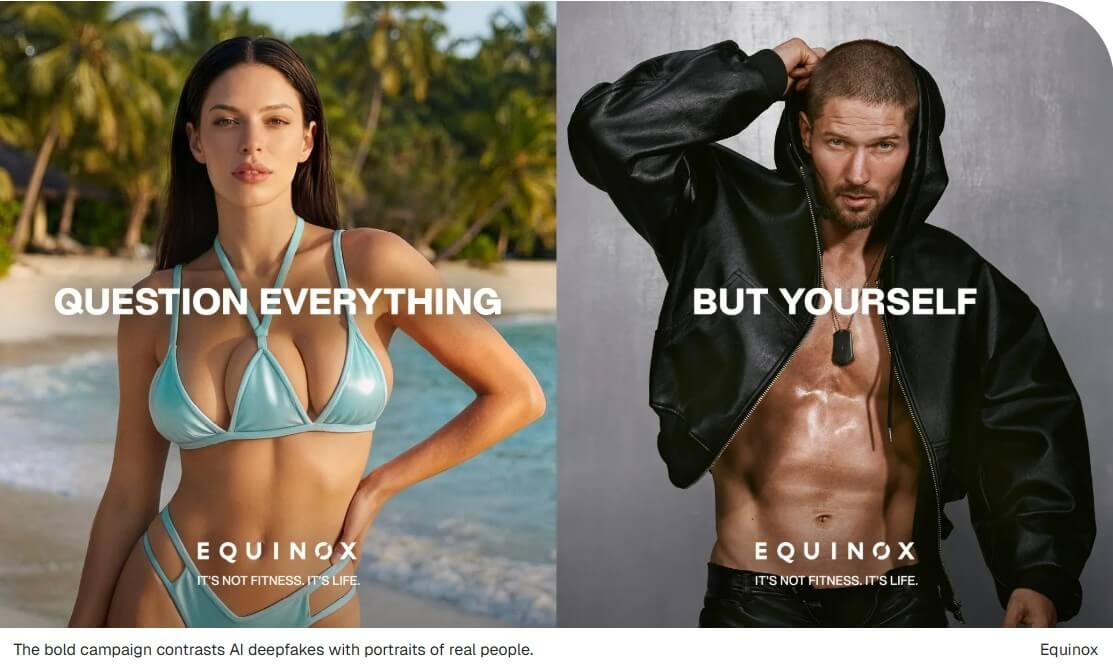
This one took a very different route—and that’s exactly why people paid attention.
Instead of trying to make AI look polished or invisible, Equinox leaned fully into the weirdness of AI-generated visuals. The campaign featured surreal, slightly unsettling imagery that didn’t look “perfect”—and wasn’t meant to.
At first glance, it almost felt confusing. But that was the point.
People started reacting to it, questioning it, even debating whether it was brilliant or bizarre. And in a crowded New Year fitness advertising space, that reaction alone set it apart.
Strategically, this campaign flipped the usual rule:
- Instead of hiding AI → it highlighted it
- Instead of aiming for mass appeal → it sparked conversation
- Instead of safe messaging → it embraced discomfort as a hook
Why it worked:
It didn’t try to please everyone. It gave people something to react to—and that reaction drove visibility.
Key takeaway:
You don’t always need AI to feel human. Sometimes, leaning into its distinct style can be the creative idea—especially if your goal is to stand out.
8. Apple — The Day the World Danced (Shot on iPhone)
This is what large-scale storytelling looks like when you don’t rely on scripts.
In 2025–2026, Apple took its long-running Shot on iPhone platform and pushed it into a global, real-time moment. During the Super Bowl LX, the brand coordinated 23 photographers across 15 cities and 11 time zones to capture how people reacted to Bad Bunny’s halftime performance.
Every shot was captured on iPhone 17 Pro. No staged sets. No scripted reactions.
What makes this campaign stand out is the level of orchestration behind something that feels completely natural. While the output looked raw and emotional, the execution required precise planning—timing, global coordination, and creative alignment.
The final film brought together these moments into a single narrative: how one cultural event connected people around the world in real time.
And the impact was immediate—billions of impressions and over 4 billion social views within 24 hours of release.
From a strategy perspective, this campaign combined:
- User-generated style content at scale
- Live global activation tied to a major cultural moment
- Minimal brand interference, maximum authenticity
Why it worked:
It captured something real. Not a performance, but a shared human reaction.
Key takeaway:
The strongest content doesn’t always come from scripts. Sometimes, your role is to coordinate the moment—and then step back.
9. Unilever Vaseline — Vaseline Verified
This campaign is a great example of what happens when a brand actually pays attention to what people are already doing.
In 2025, Unilever noticed something interesting—there were over 3.5 million organic TikTok posts showing people using Vaseline in unexpected ways. Hacks, DIY fixes, beauty tricks—none of it created by the brand.
Instead of jumping in with ads, they did something smarter.
They brought those ideas into the lab.
R&D scientists tested hundreds of these viral hacks and introduced a #VaselineVerified seal for the ones that actually worked. Suddenly, community content wasn’t just “viral”—it was validated.
That shift changed everything.
The campaign didn’t feel like marketing. It felt like recognition. People who had been experimenting with the product were now part of the brand story.
Strategically, this worked because:
- Social listening became the starting point, not an afterthought
- Science added credibility without removing authenticity
- The community stayed at the center, not the brand
The impact followed—136 million social views in just three months, along with major recognition at Cannes Lions International Festival of Creativity, including a Titanium Lion and two Grand Prix.
Why it worked:
It didn’t create a narrative from scratch. It amplified one that already existed—and proved it.
Key takeaway:
Don’t just listen to your audience. Validate what they’re already doing and make them the heroes of your story.
10. IKEA — Wherever Life Goes (Price Tags That Tell Life Stories)
This campaign is a great reminder that you don’t always need a complex idea—you just need to look at something ordinary in a different way.
IKEA took one of the most overlooked elements in its stores—the price tag—and turned it into a storytelling device.
Instead of just listing cost and product details, the tags began reflecting real-life moments. Moving into your first apartment. Sharing a small space with someone. Late nights, early mornings, quiet routines.
Suddenly, a simple product wasn’t just a product anymore. It became part of a life situation people could recognize instantly.
What makes this interesting is how scalable it is. The same idea worked across:
- In-store experience
- Out-of-home placements
- Social and film storytelling
All without losing consistency.
Strategically, this campaign focused on:
- Turning functional elements into emotional touchpoints
- Using universal life moments instead of complex narratives
- Keeping execution simple but deeply relatable
Why it worked:
It met people where they already were—in everyday life. No big concept to decode, just something that felt true.
Key takeaway:
You don’t always need a new format. Sometimes, the most overlooked parts of your brand can become your strongest storytelling tools—if you give them meaning.
11. Salesforce x MrBeast — Super Bowl Collaboration Announcement
This campaign proves something most brands overlook—the announcement itself can be the campaign.
In 2026, Salesforce made an unexpected move. Instead of quietly producing a Super Bowl ad, the CEO publicly invited MrBeast to direct it.
That’s it. No teaser film. No early visuals.
Just the idea.
And that idea spread fast.
Because on paper, it didn’t make sense. A B2B enterprise software company partnering with one of the biggest Gen Z creators? That contrast became the story. People weren’t just interested in the ad—they were curious about what this pairing would even look like.
From a strategy perspective, this worked on a few key levels:
- Cross-audience reach: Blended enterprise buyers with mass consumer attention
- Earned media first: The announcement generated buzz before production even mattered
- Curiosity-driven narrative: The “why this pairing?” question fueled conversation
It shifted focus from execution to anticipation.
Why it worked:
The surprise created immediate attention. People shared the idea before they even saw the output.
Key takeaway:
The right unexpected partnership can generate more buzz in the announcement than most campaigns do after launch. Sometimes, the idea alone is enough to carry the story.
12. Rare Beauty — Scratch-and-Sniff Billboard Launch
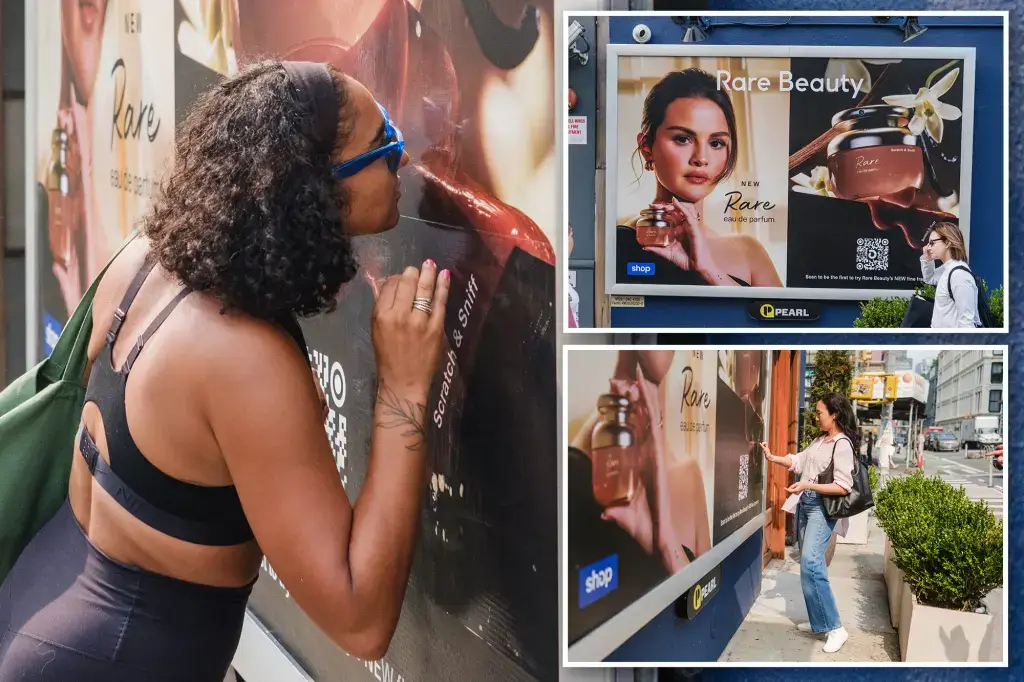
This campaign stands out because it brought something most outdoor ads ignore—a sensory experience.
In 2025, Rare Beauty, founded by Selena Gomez, introduced scratch-and-sniff billboards to promote its fragrance line. Instead of asking people to imagine the scent, the brand let them experience it directly—right there on the street.
It’s a simple idea, but strategically sharp.
Beauty advertising often relies heavily on visuals and aspirational messaging. Rare Beauty flipped that by focusing on product trial in a public space—something usually limited to in-store experiences.
The execution turned a passive format (billboards) into an interactive touchpoint:
- People physically engaged with the ad
- The novelty encouraged social sharing
- The experience reduced the gap between awareness and trial
It also aligned closely with the brand’s identity—accessible, real, and grounded in everyday moments rather than high-gloss exclusivity.
Why it worked:
It removed guesswork. Instead of telling people what the product feels like, it let them experience a part of it instantly.
The result:
High footfall engagement, strong social amplification, and increased curiosity around the product launch.
Innovation type:
Sensory Marketing + Experiential OOH + Product Sampling Reinvented
Key takeaway:
If your product relies on sensory appeal, don’t just describe it. Find a way to let people experience it—even in unexpected places like a billboard.
13. Nike — So Win Super Bowl Campaign
This campaign is a strong reminder that sometimes, the most powerful message is the simplest one.
In February 2025, Nike returned to the Super Bowl after 27 years—and instead of showcasing products, it delivered a bold, three-word statement: “So Win.”
The message was directed at female athletes, particularly those who constantly face criticism, doubt, or unrealistic expectations. There was no detailed storytelling, no feature breakdown—just a clear emotional stance.
That’s what made it stand out.
In a space where most Super Bowl ads compete for attention with humor or spectacle, Nike chose clarity and conviction. The campaign felt more like a rallying cry than an advertisement.
Strategically, it worked because:
- Message-first approach: No product distraction, just a strong point of view
- Cultural alignment: Tapped into ongoing conversations around women in sports
- Designed for sharing: Short, repeatable, and easy to rally behind
Why it worked:
People didn’t just watch it—they repeated it. The simplicity made it easy to share, quote, and turn into a statement of identity.
The result:
It became one of the most shared and talked-about moments of the Super Bowl 2025.
Key takeaway:
Social-first campaigns don’t need complexity. One clear line—if it resonates—can travel further than a full narrative.
14. Spotify — Wrapped 2025 Campaign
This campaign shows what happens when personalization becomes something people look forward to, not just something happening in the background.
In December 2025, Spotify pushed its annual Wrapped experience further by introducing a “visual mixtape” format, along with a new Listening Age feature that reframed user data in a more playful, identity-driven way.
Instead of just showing stats, Wrapped felt like a story—your story.
What made 2025 different was how Spotify expanded beyond the app. The campaign included 50 global physical pop-up installations, turning a digital experience into something people could step into, photograph, and share.
So it wasn’t just personal—it became social at scale.
Strategically, this campaign worked because:
- Data was turned into identity, not just information
- The format was highly shareable, designed for screenshots and reposts
- Digital met physical, extending reach beyond screens
The response was immediate—200 million users engaged within the first 24 hours, and over 13.6 million mentions within a month.
Why it worked:
People didn’t feel like they were consuming a campaign. They felt like they were part of it.
Key takeaway:
When personalization reflects identity, people will share it for you. The more it feels like “this is me,” the further it travels.
15. Dunkin’ x Sabrina Carpenter — Espresso Collab
This campaign worked because it didn’t feel like a partnership—it felt like a natural extension of what was already happening in culture.
In early 2025, Dunkin’ teamed up with Sabrina Carpenter at the exact moment her song Espresso was dominating streaming platforms.
Instead of forcing a connection, the brand leaned into something that already made sense—espresso as both a product and a cultural moment.
The campaign introduced a themed drink tied directly to the song, supported by visuals and content that matched Carpenter’s aesthetic and tone. It felt cohesive, not like a brand borrowing attention.
Strategically, this worked because:
- Timing was precise: The campaign launched while the song was still peaking
- Brand-product alignment was obvious: No explanation needed
- Fan culture drove distribution: Fans of the artist amplified the campaign naturally
The results reflected that—340 million impressions and a 34% increase in product sales during the promotion period.
Why it worked:
It didn’t try to create a trend. It stepped into one at the right time, with the right fit.
Key takeaway:
The best collaborations don’t feel forced. When the connection is obvious, the audience does the marketing for you.
16. Coca-Cola — Share a Coke Memory Maker Relaunch
This campaign shows how a legacy idea can stay relevant without losing what made it work in the first place.
In April 2025, Coca-Cola brought back Share a Coke—but this time, it wasn’t just about seeing your name on a bottle. It was about turning that moment into something you could create and share.
The familiar name-label bottles returned across 120+ countries, but now each one connected to a digital layer. By scanning a QR code, users could access the Memory Maker hub, where they could generate personalized videos using their name and moments.
So the campaign moved from physical personalization → digital storytelling.
What’s interesting here is the balance. Coca-Cola didn’t try to reinvent the idea. It kept the emotional trigger (finding your name) and simply extended it into a format built for today’s sharing behavior.
Strategically, this worked because:
- Nostalgia anchored the campaign, making it instantly recognizable
- Technology added depth, not complexity
- User participation became the core distribution channel
The result was steady engagement—6.2 million video views within 8 months, alongside a confirmed global rollout.
Why it worked:
It respected what people already loved, while giving them a new way to interact with it.
Key takeaway:
You don’t always need a new idea. Sometimes, updating a familiar one with the right layer of interactivity is enough to make it relevant again.
17. Almond Breeze — It’s Really Good (2026)
This campaign stands out because it did something most brands weren’t willing to do in 2025–2026—it questioned the AI hype instead of joining it.
Almond Breeze partnered with the Jonas Brothers to create a series of ads that mocked bad AI-generated marketing.
The setup is simple but clever.
In the main film, fictional “agency creatives” pitch increasingly absurd AI-generated ad ideas—like the band floating in space or starring in over-the-top, unrealistic scenarios. The ideas look flashy, but they feel empty.
And then the twist happens.
The Jonas Brothers reject all of it and land on the simplest possible message:
“Almond Breeze. It’s really good.”
That contrast is the campaign.
Strategically, this worked on multiple levels:
- Cultural insight: People were already getting tired of low-quality AI content flooding feeds
- Creative inversion: Instead of using AI to impress, they used it as the joke
- Authenticity positioning: The brand positioned itself as “real” in a space starting to feel artificial
Even the production reinforced this idea—the Jonas Brothers were involved in shaping the creative, making it feel less like a paid endorsement and more like participation.
Why it worked:
It tapped into a growing skepticism. Instead of adding more noise, it cut through it with honesty—and humor.
Innovation type:
Anti-AI Creative Strategy + Cultural Commentary + Celebrity-Led Storytelling
Key takeaway:
When a trend becomes overcrowded, you don’t have to follow it. Sometimes, the smartest move is to push back—and say less.
18. Mattel — Barbie Type 1 Diabetes Doll
This campaign is a strong example of purpose done with depth, not just messaging.
In 2025, Mattel introduced its first Barbie representing children living with Type 1 diabetes. But this wasn’t just a symbolic launch—the execution focused heavily on accuracy and real-life representation.
The doll was developed in collaboration with Breakthrough T1D, ensuring that every detail reflected reality. It included:
- A continuous glucose monitor (CGM) on the arm
- A wearable insulin pump
- A phone displaying blood sugar tracking
- Visual cues aligned with diabetes awareness
These weren’t random add-ons—they mirrored what millions of people actually use daily.
What makes this campaign stand out is that it didn’t rely on a traditional “ad.” The product itself was the message.
For children living with diabetes, this wasn’t just a doll—it was representation. For everyone else, it became a subtle but powerful way to normalize a condition that’s often misunderstood.
Strategically, this worked because:
- Purpose was embedded in the product, not added later
- Partnership added credibility, not just visibility
- Representation created emotional connection, especially with underserved audiences
It also fits into Mattel’s broader push toward inclusivity, with its Barbie line already expanding across body types, abilities, and backgrounds.
Why it worked:
It moved beyond awareness and into representation people could hold in their hands.
Key takeaway:
Purpose marketing works best when it’s built into what you create—not just what you say.
19. Gap — Better in Denim
This campaign is a great example of how a brand can rebuild cultural relevance by going back to what originally worked—then adapting it for today.
In Fall 2025, Gap launched Better in Denim, a campaign centered around music, movement, and self-expression. It featured global girl group KATSEYE performing high-energy choreography to Milkshake—a track that already had strong nostalgia and TikTok traction.
But this wasn’t just a fashion ad.
It was designed as a cultural moment:
- A diverse cast of dancers and global talent
- A strong Y2K aesthetic (low-rise denim, throwback styling)
- A format that felt native to social platforms (dance, music, repetition)
Gap intentionally leaned into its past—reviving the spirit of its iconic dance-led ads from earlier decades—while making it relevant for Gen Z audiences.
The result was massive reach:
- 8+ billion impressions
- 500+ million views
- Double-digit growth in denim sales
But more importantly, it became something people wanted to watch, not skip.
Strategically, this campaign worked because:
- Nostalgia met modern culture (old Gap style + TikTok-native format)
- Music and movement drove engagement, not product features
- The product stayed visible, but never forced
Why it worked:
It didn’t try to reinvent the wheel—it reintroduced a familiar format in a way that felt current.
Key takeaway:
Sometimes innovation isn’t about doing something new. It’s about bringing back what worked—and making it fit how people consume content today.
20. Canva x Stink Studios — Can You Make the Logo Bigger?
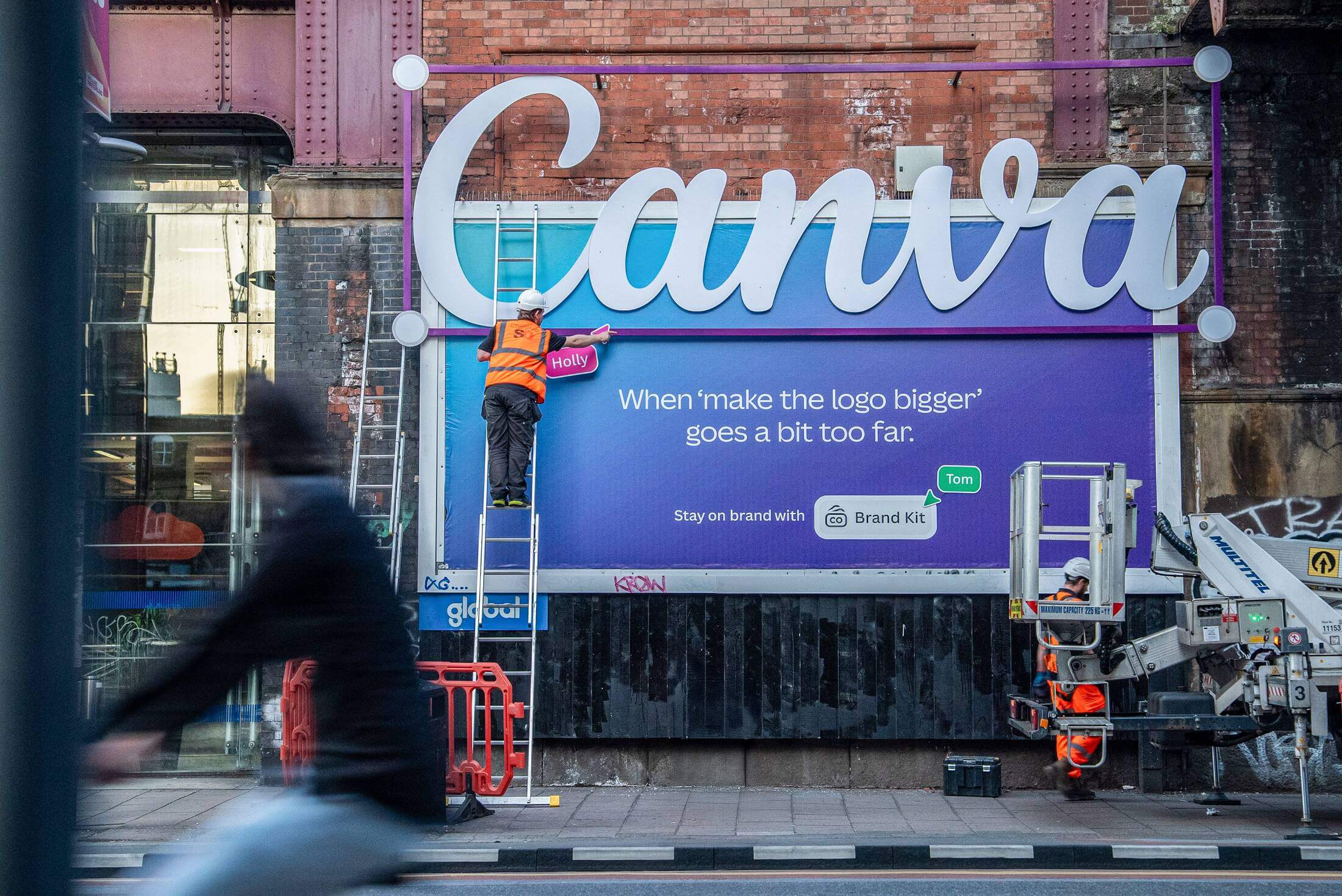
This campaign worked because it did something most brands avoid—it laughed at a problem everyone in its audience understands.
In 2025, Canva partnered with Stink Studios to turn one of the most common (and frustrating) client requests—“Can you make the logo bigger?”—into the entire idea.
Instead of explaining features, they built a series of outdoor installations at London’s Waterloo Station, where billboards literally exaggerated real design chaos:
- Logos bursting out of frames
- Layouts flipped incorrectly (16:9 → 9:16)
- Objects “dragged and dropped” into real-world spaces
It wasn’t just visual humor—it was shared experience.
Every designer, marketer, or creator passing by instantly recognized the joke. And that recognition created an emotional connection that traditional SaaS ads rarely achieve.
Strategically, the campaign worked because:
- It spoke the audience’s language (insider humor, not corporate messaging)
- Pain points became the creative idea, not something to hide
- Execution doubled as product demo, subtly showing Canva’s tools in action
It also flipped criticism into strength. Instead of defending itself against “not real design” debates, Canva showed it understands the creative process—and the chaos that comes with it.
Why it worked:
It made the audience feel seen. Not targeted—understood.
Key takeaway:
If your audience shares a common frustration, don’t avoid it. Turn it into the idea. The more specific and relatable it is, the stronger the connection.
6 Key Strategies Behind Every Winning Campaign in 2025–2026
If you step back and analyze the campaigns we just covered, a clear structure starts to emerge. Different formats, industries, and budgets—but the same strategic patterns keep repeating.
Here’s how I’d break it down, along with how I’d recommend you actually apply these in real campaigns.
1. Start With a Cultural Insight, Not a Product
The strongest campaigns begin with a real-world behavior or tension, not a product feature.
This could be:
- A trending topic people are already discussing
- A shift in consumer behavior
- A shared frustration or inside joke
When you anchor your campaign in something culturally relevant, you reduce the effort needed to grab attention.
I’d recommend:
Spend more time studying your audience’s environment (social media, communities, trends) than your own product brief. The insight should feel obvious after you see it.
2. Make the Audience Part of the Story
Campaigns today are no longer one-way communication. The most effective ones are participatory by design.
This includes:
- User-generated content (UGC)
- Personalization (data-driven outputs)
- Interactive formats (polls, challenges, tools)
When people contribute, they also distribute.
My recommendation:
Build a clear participation mechanic from day one. Ask yourself: What action can the audience take that naturally spreads this idea?
3. Keep the Idea Simple, Execution Strong
A common misconception is that innovation requires complexity. In reality, most high-performing campaigns are built on simple, easy-to-grasp ideas.
Examples of simple structures:
- A repeatable line or phrase
- A single visual device
- A clear, focused narrative
The sophistication comes from execution—timing, design, distribution—not the idea itself.
I’d suggest:
Pressure-test your idea: can someone understand and repeat it in a few seconds? If not, refine it.
4. Use Technology With Clear Purpose
AI, AR, and personalization are widely used—but only effective when they improve the user experience in a visible way.
Poor use of tech:
- Adds complexity without value
- Feels like a gimmick
Strong use of tech:
- Solves a real user need
- Feels natural within the experience
My take:
Only introduce technology if it answers a clear question: What does this make easier, faster, or more engaging for the user?
5. Design for Sharing From the Start
Distribution is no longer something you “add later.” The most successful campaigns are engineered for sharing at the concept stage.
Common sharing triggers include:
- Identity (“this represents me”)
- Emotion (humor, pride, surprise)
- Utility (useful or personalized outputs)
I’d recommend:
Define your primary sharing unit early—Is it a short video? A screenshot? A phrase?
Then build the campaign around that format.
6. Create a Moment, Not Just a Message
Modern campaigns succeed when they feel like events or experiences, not just advertisements.
This could be:
- A live activation
- A cultural tie-in (sports, music, internet trends)
- A limited-time or unexpected execution
Moments create urgency and relevance. Messages alone often get ignored.
My recommendation:
Think in terms of timing and context: Why should people care about this right now?
If there’s no clear answer, the campaign may struggle to break through.
| Strategy | What It Means in Practice |
|---|---|
| Start With a Cultural Insight | Build your campaign around something already happening—trends, behaviors, or conversations your audience is part of. This reduces the effort needed to grab attention and makes the campaign feel natural. |
| Make the Audience Part of the Story | Design participation into the campaign—UGC, personalization, or interactive formats—so people contribute and distribute the content themselves. |
| Keep the Idea Simple | Focus on a clear, easy-to-understand concept (a line, visual, or core idea) and invest in strong execution rather than complexity. |
| Use Technology With Purpose | Only use AI, AR, or automation when it improves the user experience. The technology should support the idea, not become the idea. |
| Design for Sharing | Build the campaign with a clear sharing trigger—emotion, identity, or utility—and define the format people will naturally repost (video, screenshot, phrase). |
| Create a Moment, Not Just a Message | Tie your campaign to a specific moment—events, cultural trends, or live activations—so it feels timely, relevant, and worth paying attention to. |
Pro Tip: “You don’t need a Super Bowl budget. You need a sharp insight, a coordinated team, and the courage to commit to the idea fully.”
How Any Brand Can Apply These Strategies Right Now
You don’t need a massive budget or a global campaign to apply these ideas. The real advantage comes from clarity, timing, and execution. Here’s a practical way to approach it:
Step 1: Identify One Real Conversation
Start by analyzing what your audience is already discussing—on social platforms, communities, reviews, or support queries.
Instead of creating a new narrative, enter an existing one. This makes the campaign feel relevant and reduces the effort required to capture attention.
Step 2: Map to a Single Core Emotion
Every effective campaign is anchored in one dominant emotion—such as joy, curiosity, pride, or humor.
This emotional focus ensures consistency across messaging, visuals, and content. When the emotion is clear, the campaign becomes easier to understand and share.
Step 3: Choose a Participatory Format
Campaigns perform better when audiences can actively engage rather than passively consume.
This could include:
- User-generated content
- Interactive formats
- Personalized outputs
A clear participation mechanism increases both reach and engagement.
Step 4: Align Teams Early
Successful campaigns require coordination across teams—marketing, product, content, and data.
Early alignment ensures:
- A consistent message
- Clear roles and responsibilities
- Strong execution across channels
This prevents fragmentation during launch.
Step 5: Test a Small Version First
Before scaling, validate the idea with a smaller execution:
- Short-form content
- Limited audience rollout
- Pilot campaigns
Testing helps identify what resonates and reduces risk before full investment.
Step 6: Measure What Matters
Impressions alone don’t reflect true impact.
Focus on metrics that indicate deeper engagement:
- Shares and reposts
- Volume of user-generated content
- Brand sentiment
- Retention and repeat interaction
These signals provide a clearer picture of campaign effectiveness.
Run Your Entire AI Marketing Workflow in One Place with Simplified
If you look at the campaigns we just covered, they all have one thing in common—everything works together behind the scenes.
Content, design, timing, distribution—it’s all connected. And that level of coordination is what most teams struggle with.
That’s where Simplified comes in.
It acts as an AI-powered marketing platform with built-in workflow automation, helping you connect every part of your campaign in one place—so your ideas don’t get stuck in execution.
Instead of juggling multiple tools, you can:
- Create content, visuals, and videos using AI
- Automate workflows from ideation to publishing
- Schedule and manage campaigns across platforms
- Collaborate with your team without constant back-and-forth
- Keep your messaging consistent across every channel
The real advantage is how everything flows together.
You’re not manually moving tasks from one tool to another. The system handles the coordination—so your team can focus on building campaigns that actually stand out.
If this list sparked an idea, don’t let it sit in a doc.
Final Thoughts
If I had to sum up everything we’ve covered, it’s this—the campaigns that stood out in 2025–2026 weren’t the loudest or the most expensive.
They were the most disciplined. The most human. And often, the most unexpected.
What really stands out to me is the consistency across all of them. Different industries, different formats—but every single campaign did one thing right:
it made people feel something first, before asking them to do anything.
That shift is important.
Because attention today isn’t something you can demand—it’s something you earn. And emotion is what earns it.
I also think there’s a misconception that this level of creativity is only possible for big brands. It’s not.
From what I’ve seen, innovation doesn’t start with budget.
It starts with:
- One sharp, clear insight
- A team that’s aligned from the beginning
- And the willingness to fully commit to an idea
That’s it.
If you get those three right, the scale can come later.
What You Can Do Next
Now I’m curious—which of these campaigns stood out to you the most?
Pick one strategy from this list and try it in your next campaign.
Not all six. Just one.
Test it. Learn from it. Build on it.
That’s how the best campaigns actually come together.
FAQ — Innovative Marketing Campaigns (2025–2026)
What are the most innovative marketing campaigns of 2025–2026?
The most innovative campaigns from 2025–2026 are the ones that focused on emotion, participation, and cultural timing rather than just promotion. Examples include Nike’s So Win Super Bowl campaign, Spotify Wrapped 2025, Coca-Cola’s Share a Coke relaunch, and Apple’s global Shot on iPhone activation. What sets them apart is that they didn’t feel like ads—they felt like moments people wanted to engage with and share.
What makes a marketing campaign truly innovative?
A campaign is truly innovative when it combines four things:
- A clear emotional trigger
- Cultural relevance (it fits into ongoing conversations)
- Purposeful use of technology
- Built-in sharing or participation
In simple terms, innovative campaigns don’t just deliver a message—they create an experience people want to be part of.
How are global brands using AI in their marketing campaigns in 2026?
In 2026, brands are using AI more subtly and strategically. Instead of showcasing AI as a feature, they’re using it to:
- Personalize user experiences (like Spotify Wrapped)
- Power everyday use cases (like ChatGPT in daily tasks)
- Create distinct creative styles (like experimental AI visuals in campaigns)
The key shift is this: AI is supporting the experience, not dominating it.
What is the difference between viral marketing and innovative marketing?
Viral marketing focuses on reach and rapid sharing, often driven by trends or shock value.
Innovative marketing, on the other hand, focuses on original thinking and meaningful engagement.
A campaign can go viral without being innovative, but the most effective campaigns today are both—because they combine strong ideas with shareable formats.
How can small brands run innovative campaigns on a limited budget?
Small brands don’t need big budgets—they need clarity. The most practical approach is:
- Start with a real audience insight
- Focus on one emotion
- Use simple, participatory formats (UGC, social content)
- Test small before scaling
Many successful campaigns started as simple ideas executed well. Relevance matters more than scale.
What is product-led growth and why is it a marketing strategy?
Product-led growth (PLG) is a strategy where the product itself drives user acquisition, engagement, and retention.
Instead of relying only on ads, the product becomes the main marketing channel—through free trials, shareable features, or built-in experiences.
It works because users experience value first, which naturally leads to adoption and advocacy.
What are the best content marketing examples that generated real leads?
The most effective content marketing examples in 2025–2026 share a few traits:
- They provide real value (education, entertainment, or utility)
- They are designed for sharing (short videos, interactive formats)
- They connect to a clear user need
Campaigns like Spotify Wrapped, Canva’s Can You Make the Logo Bigger?, and Vaseline Verified worked because they didn’t just attract attention—they kept people engaged and drove ongoing interaction, which ultimately leads to conversions.