By
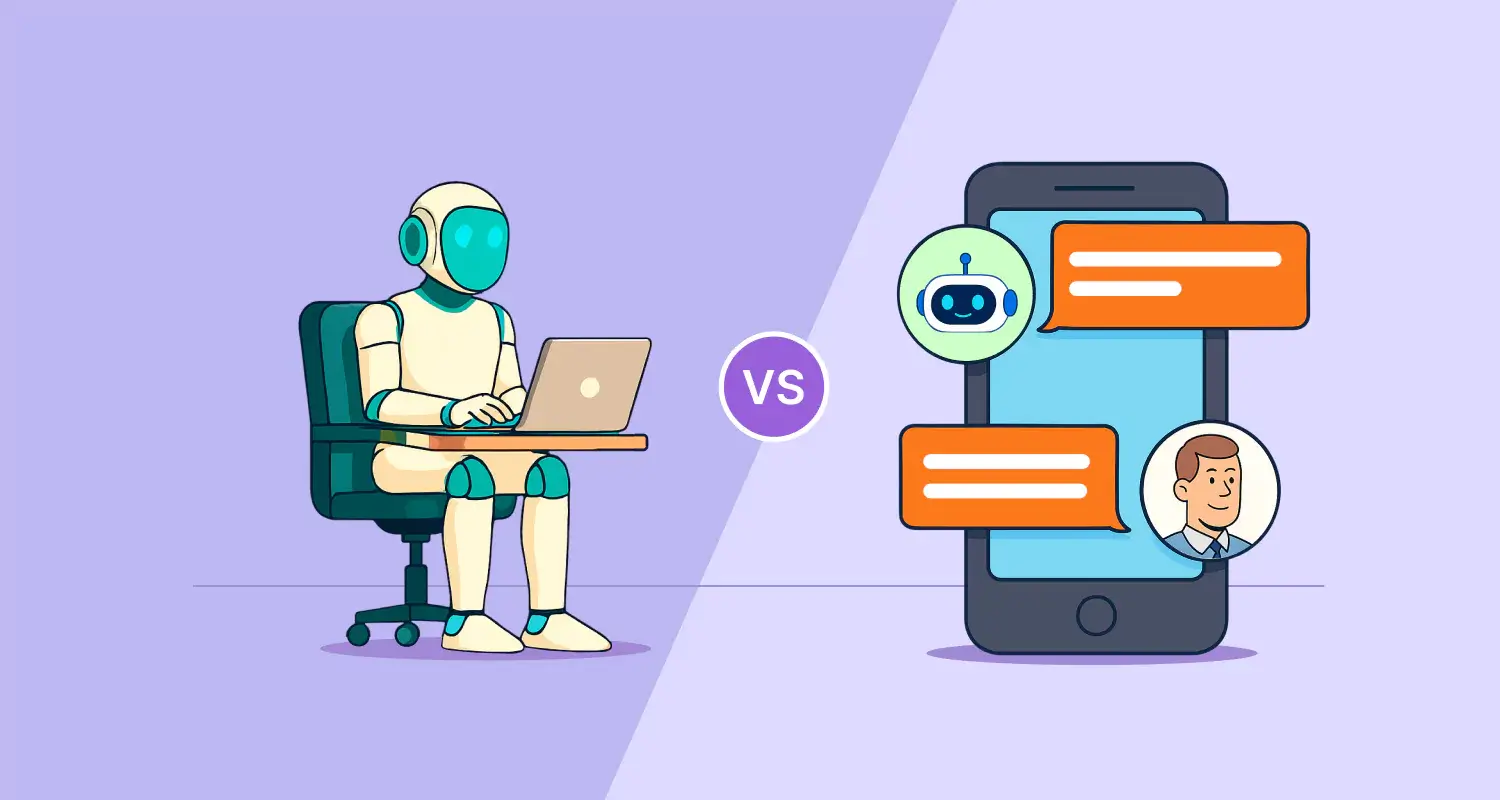
The difference between an AI agent and a chatbot is simple: a chatbot answers questions, while an AI agent completes tasks. A chatbot responds to what you type within one conversation. An AI agent takes a goal, plans the steps, uses other tools, and does the work, usually checking with you before anything important goes out.
That distinction matters more than it sounds. Confusing the two is like confusing a calculator with an accountant. One answers the question you ask. The other figures out which questions to ask in the first place, then handles the work.
Most “AI agent vs chatbot” guides are written for enterprise IT teams buying customer-service platforms. This one is for small businesses and lean marketing teams deciding where to spend a limited budget. You’ll get a side-by-side comparison, real marketing examples, where ChatGPT fits, and a three-question test to pick the right tool.
Key Takeaways
- A chatbot reacts: it answers questions inside a conversation. An AI agent acts: it plans and completes multi-step tasks across tools.
- Chatbots are the better choice for 24/7 customer support, FAQs, and lead capture. They’re faster to set up and more predictable.
- AI agents are the better choice for work with many steps, like producing and publishing a week of social content.
- ChatGPT is mostly a chatbot-style assistant, though newer versions can act as agents for some tasks.
- Most small businesses benefit from both: a chatbot on the front line and an agent behind the scenes, with human approval before anything ships.
What is a chatbot?
A chatbot is a conversational AI tool that responds to user input. You ask a question, it gives an answer. The interaction is reactive: the chatbot waits for you, processes your request, and replies.
Most chatbots fall into two categories:
- Rule-based chatbots that follow pre-written decision trees (“If the user says X, respond with Y”)
- AI-powered chatbots that use large language models to understand natural language and write flexible responses
Even advanced AI chatbots share one core trait: they work inside a single conversation. They answer questions, share information, and guide people through simple flows. When the conversation ends, so does their involvement.
Think of the chat widget on a website that helps you find business hours, check order status, or search a help center. That’s a chatbot doing what it does best.
Tools like Simplified’s AI Chatbot let you train a chatbot on your own business data. Upload your documents, FAQs, and product info, and it answers customer questions around the clock on your website, WhatsApp, Instagram, and Messenger. It captures leads and hands off to a human when needed.
For many businesses, that’s exactly the right tool. Not every problem needs an autonomous AI system.
What is an AI agent?
An AI agent is an AI system that plans, reasons, and takes multi-step actions to reach a goal. Unlike a chatbot, an agent doesn’t need you to direct every step. You give it an objective, and it figures out how to get there.
Here’s what makes an AI agent different:
- Goal-driven: You define the outcome, not each step
- Autonomous: The agent decides which actions to take, and in what order
- Tool-using: It connects to other systems (your CRM, analytics, design tools, social accounts) and takes real actions
- Persistent: It keeps working across steps and sessions, not just one conversation
- Adaptive: It adjusts based on results
For example, a chatbot can answer “What’s our top-performing blog post?” An AI agent can find the posts losing traffic, research what’s outranking them, draft updates, and queue them for your review, all from one request.
Gartner predicts that by 2028, at least 15% of day-to-day work decisions will be made autonomously by AI agents. For marketing specifically, our guide to AI marketing agents covers what they can take off your plate today.
AI agent vs chatbot: side-by-side comparison
The clearest way to see the difference between a chatbot and an AI agent is to compare them directly:
| Feature | Chatbot | AI Agent |
|---|---|---|
| How it works | Responds to prompts | Pursues a goal |
| Interaction model | Reactive (waits for input) | Proactive (takes initiative) |
| Autonomy | Low: follows scripts or answers | High: plans and carries out steps |
| Scope | One conversation | Multi-step work across systems |
| Tool access | Limited or none | Connects to apps, data, and accounts |
| Memory | Usually per session | Persists across tasks |
| Setup effort | Low: live in hours | Moderate: needs goals and guardrails |
| Human oversight | Hand-off to a person when stuck | Approval checkpoints before actions |
| Best for | Support, FAQs, lead capture | Content production, operations, follow-up |
The short version: if an AI system only talks, it’s a chatbot. If it can decide what to do next and take action across tools, it’s an AI agent.
AI agent vs AI assistant: where does ChatGPT fit?
You’ll also see “AI assistant” used for tools like ChatGPT, Claude, and Gemini. An AI assistant sits between the two: it’s conversational like a chatbot, but far more capable. It can write, analyze, and reason across almost any topic.
Is ChatGPT an AI agent? Mostly no, by default. In everyday use, ChatGPT works like a very capable chatbot or assistant: you ask, it answers. Newer versions add agent-style features that can browse, use tools, and complete multi-step tasks. Whether it’s acting as an agent depends on whether it’s taking actions toward a goal or just replying to you.
A practical way to think about it:
- Chatbot: answers your customers’ questions on your site
- AI assistant: helps you think, write, and plan
- AI agent: does the work, like making and scheduling the posts, with your approval
AI agent vs chatbot: when to use a chatbot
Chatbots aren’t the “lesser” option. For many jobs, they’re the better choice: faster to set up, easier to manage, and more predictable.
Use a chatbot when:
- You need 24/7 customer support. A chatbot trained on your help docs handles repetitive questions about pricing, products, shipping, and returns.
- You want lead capture on autopilot. Chatbots can qualify visitors, collect contact details, and route leads, even after hours.
- The workflow is linear. If the task follows a predictable path (question → answer), a chatbot handles it well.
- You need it live this week. Most chatbot tools, including Simplified’s AI Chatbot, go from zero to live in hours.
A small business owner who answers the same 20 customer questions every day doesn’t need an AI agent. They need a good chatbot.
When to use an AI agent instead of a chatbot

AI agents shine when the work is too complex, too variable, or too time-consuming for a Q&A exchange.
Use an AI agent when:
- The task involves multiple steps and tools. Planning a campaign, writing posts, creating graphics, and scheduling across platforms is agent work, not a chatbot conversation.
- You want the work done, not described. A chatbot can tell you what to post. An agent can make the posts and queue them.
- You’re automating follow-up. Scoring leads, personalizing outreach, and updating your CRM is a multi-step process agents handle end to end.
- You need content at a steady pace. Turning one blog post into a week of social content across channels is where agents save the most time.
For marketing, Simplified’s marketing agent, Riley, is built for exactly this. It plans the campaign, creates the posts, visuals, and short videos in your brand’s colors, fonts, and voice, then publishes to your social channels after you approve. Approvals are on by default; auto-publish is opt-in.
If you’d rather design your own multi-step automations, AI workflow automation lets you chain agents together visually, with human approval steps where they matter.
AI agent vs chatbot: real marketing examples
Here’s how the AI agent vs chatbot choice plays out on jobs small businesses actually face.
Scenario 1: Handling customer questions
Chatbot approach: A visitor lands on your site at 11 p.m. and asks about your return policy. The chatbot, trained on your support docs, answers right away, offers to start a return, and captures the customer’s email. Done in 30 seconds.
Agent approach: Overkill. You don’t need autonomous planning to answer a return-policy question. A chatbot is faster, cheaper, and more predictable here.
Winner: Chatbot.
Scenario 2: Weekly social content
Chatbot approach: You ask a chatbot for an Instagram caption. Then a LinkedIn version. Then you open a design tool for the graphic, then your scheduler. Four tools and most of your afternoon.
Agent approach: Picture Maya, who runs marketing alone for a 10-person yoga studio.
On Monday she tells Simplified’s marketing agent, Riley: “Promote our new beginner class this week.” By the afternoon her approval queue has five Instagram posts, two LinkedIn posts, a short video, and captions in the studio’s voice.
She edits one caption, approves the rest, and they go out on schedule.
Winner: AI agent.
Scenario 3: Lead follow-up
Chatbot approach: A lead fills out your contact form. The chatbot sends “Thanks, we’ll be in touch.” Then someone on your team checks the CRM and writes a follow-up by hand. Hours pass.
Agent approach: The agent scores the lead against your criteria, drafts a personalized email based on their industry, and queues it for your review. If the lead replies, it routes them to the right person with full context.
Winner: AI agent.
How chatbots became agents
The history explains why both tools still matter.
Phase 1: Rule-based chatbots. Simple decision trees. “Press 1 for sales, 2 for support.” Limited and often frustrating, but useful for basic questions.
Phase 2: AI-powered chatbots. Large language models made chatbots far smarter. They could understand natural language, handle nuance, and write human-sounding replies. This is where most businesses are today.
Phase 3: AI agents. The newest step adds goals, tool use, and multi-step reasoning. Agents don’t just talk; they act inside your existing tools.
Each phase didn’t replace the last. Rule-based bots still run phone menus. AI chatbots still handle most customer support. Agents are taking on the multi-step work in between.
So the right question isn’t “chatbot or agent?” It’s “what does this specific job need?”
What this means for small businesses
If you run a small business or a lean marketing team, here’s the practical path:
Start with a chatbot for customer-facing questions. Answer support questions, capture leads, and respond instantly. The payoff is quick: fewer repeated questions and leads captured while you sleep.
Add an agent for the behind-the-scenes work. Content creation, social media management, lead follow-up, and reporting are where agents save the most time.
Use both. A chatbot handles the front line. An agent handles the work that keeps your marketing running. Simplified offers both in one place: an AI Chatbot for support and lead capture, and Simplified’s marketing agent, Riley, for planning, creating, and publishing your marketing, alongside AI tools for small business like design, writing, and video.
Picture Tom, who owns a two-location bike shop.
He added a chatbot first, and it now answers about 40 “are you open Sunday?” and “do you service e-bikes?” questions a week. Three months later he added an agent for social media, so his Instagram finally posts more than once a month.
The chatbot gave him back his inbox. The agent gave him back his evenings.
How to decide: a quick framework
Still not sure which you need? Answer three questions:
- Is the task conversational or operational? If someone asks a question and needs an answer, use a chatbot. If work needs to get done across steps and systems, use an AI agent.
- How predictable is it? Repeated, predictable tasks (FAQs, order status, booking) suit a chatbot. Variable tasks that need judgment (content, campaigns, lead scoring) suit an agent.
- What’s the cost of a mistake? For low-stakes conversations, chatbots are simpler. For higher-stakes work, choose an agent with approval checkpoints so nothing goes out without your OK.
If you’re weighing specific tools, see how we compare AI marketing agents for small business.
FAQ
What is the main difference between an AI agent and a chatbot?
A chatbot answers questions inside a conversation; an AI agent completes tasks. The agent takes a goal, plans the steps, uses other tools, and acts, usually with your approval before anything important happens.
Is ChatGPT a chatbot or an AI agent?
By default, ChatGPT works like an advanced chatbot or AI assistant: you ask, it answers. Some newer features let it act more like an agent, browsing the web or using tools to finish multi-step tasks. It depends on how you use it.
Are AI agents just bots?
No. Bots typically follow scripts or answer prompts. AI agents reason about a goal, decide what to do next, and take actions across apps. A chatbot can be one part of an agent, but an agent does far more than chat.
What are the main types of AI agents?
Textbooks usually describe five classic types: simple reflex, model-based, goal-based, utility-based, and learning agents. In practice, business AI agents are grouped by job instead: customer service agents, marketing agents, sales agents, and research or coding agents.
Do small businesses need an AI agent or a chatbot?
Most small businesses should start with a chatbot for customer questions, then add an AI agent for time-consuming work like social content and follow-up. Using both covers the front line and the back office.
Is an AI agent safe to use for my marketing?
It is when you keep a human in the loop. Choose an agent that holds drafts for your approval and lets you turn on auto-publish only where you trust it.
The bottom line on AI agent vs chatbot
The AI agent vs chatbot question isn’t really a contest. They’re teammates. Chatbots handle conversations. AI agents handle the work. The small businesses that get the most from AI in 2026 use each where it fits:
- A chatbot for 24/7 customer questions and lead capture
- An AI agent for multi-step work like content and follow-up
- Approval checkpoints so nothing ships without your OK
Start with the job you’re trying to get off your plate, and the right tool becomes obvious. If that job is your marketing, let an agent do the making while you do the deciding.