By
By 
The best social media automation tools for 2026 are Simplified, Buffer, Hootsuite, Later, Sprout Social, Postiz, Ayrshare, n8n, Zapier, SocialBee, and Make.com—each built for a different kind of user, from solo creators to developers who want to script everything from a terminal.
Here’s the honest version most roundups skip: “best” depends on whether you’re a human clicking through a dashboard or an AI agent posting through an API. Most of these tools assume the first. A few assume the second. We’ll cover both, tell you who each tool actually fits, and flag where the pricing stings.
We make one of these tools, so treat that as a bias to watch. We’ll show our work and let the comparison stand on its own.
Key Takeaways
- Simplified is the best all-in-one option—design, AI writing, video, and scheduling in one workspace from $20/month—and the only platform here with a CLI-native, agent-ready interface (
simplified-cli).- Buffer and Later are the simplest dashboards for solo creators; Hootsuite and Sprout Social fit bigger teams but start at $99+/month.
- Postiz (open-source) and Ayrshare (API-first) are the developer picks; n8n, Zapier, and Make.com are automation glue, not posting tools on their own.
- Free social media automation tools exist (Buffer, RecurPost, Postiz self-hosted, Simplified’s free plan), but most cap channels or post volume.
- If you want AI agents to run your social media, you need a tool that outputs JSON and runs headless—not a GUI built for clicking.
Social media automation tools at a glance
Before the deep dives, here’s the quick comparison. Use it to shortlist two or three, then read those sections.
| Tool | Best for | Starting price | Free tier | Agent / CLI-native |
|---|---|---|---|---|
| Simplified | All-in-one creation + scheduling | $20/mo | Yes | Yes (simplified-cli) |
| Buffer | Simple solo scheduling | $6/channel/mo | Yes | No |
| Hootsuite | Mid-size teams + listening | $99/mo | No | No |
| Later | Visual Instagram planning | $25/mo | Limited | No |
| Sprout Social | Enterprise teams + analytics | $199/seat/mo | No (trial) | No |
| Postiz | Open-source self-hosting | Free (self-host) | Yes | Partial (API) |
| RecurPost | Multi-account scheduling + content recycling | $9/mo | No (trial) | No |
| n8n | Self-hosted workflow automation | Free (self-host) | Yes | No (orchestrator) |
| Zapier | Connecting apps without code | $20/mo | Yes | No (orchestrator) |
| SocialBee | Category-based recycling | $29/mo | No (trial) | No |
| Make.com | Visual multi-step automation | $9/mo | Yes | No (orchestrator) |
| Ayrshare | Developers needing a posting API | $149/mo | Trial | API-first |
Prices reflect publicly listed plans as of June 2026 and change often—check each site before you buy.
What Social Media Automation Software actually does
Social media automation software handles the repetitive parts of posting: scheduling content in advance, publishing to multiple platforms at once, recycling evergreen posts, and pulling analytics into one report. The goal is simple—stop doing the same manual task 30 times a week.
But “automation” splits into two camps, and mixing them up leads to the wrong purchase.
The first camp is dashboard schedulers: you log in, design or upload a post, pick times, and the tool publishes for you. Buffer, Later, and Hootsuite live here. They’re built for humans who like a calendar view.
The second camp is programmatic automation: tools that connect to a social network through an API so code—or an AI agent—can post without a human clicking anything. Ayrshare and Postiz lean this way. n8n, Zapier, and Make.com sit alongside them as the wiring that triggers actions.
The newest shift is AI agents writing and publishing on their own. For that, you need a tool that runs headless and speaks JSON. That’s a small list, and it shapes the rankings below. If you’re newer to all this, our social media automation guide walks through the fundamentals first.
The 12 Best Social Media Automation Tools for 2026
1. Simplified — best all-in-one and only CLI-native option
Best for: Solo creators, small teams, and developers who want creation, scheduling, and AI agents in one place.
Most tools on this list schedule content you made somewhere else. Simplified is where you make it and schedule it—AI writing, design, video editing, and publishing to 10 platforms in one workspace. That’s the core pitch: replace Canva, Jasper, and a scheduler with one subscription, and stop copying and pasting between tabs.
The part no competitor matches yet is simplified-cli: an open-source, agent-native command-line tool. It outputs JSON, runs headless, and installs as a Claude Code plugin (/plugin marketplace add celeryhq/simplified-cli). You can list accounts, generate an AI image, and queue a post without ever opening a browser. For anyone building AI agents that run social media, that’s the difference between possible and not.
Here’s a real command—generate an image and queue a post in one short script:
export SIMPLIFIED_API_KEY="your_key_here"

# Generate an on-brand image
simplified ai-image:generate \
  --model flux.flux-realism \
  --prompt "cozy coffee shop launch announcement, warm tones" \
  --wait

# Queue the post to a connected account
simplified posts:create \
  -c "New seasonal menu drops Monday. Come for the espresso, stay for the latte art." \
  -a "<account_id>" \
  --media "<image_url>" \
  --action add_to_queue
Key features: AI writing and design, AI video (script-to-video), background removal, 10-platform scheduling, analytics, and the simplified-cli for scripting and AI agents.
Pricing: Free plan available. Pro starts at $20/month billed annually.
Pros: Create and schedule in one place; CLI and JSON output for developers; lowest entry price for this much capability; free real-time collaboration.
Cons: Not a Photoshop-level design tool or a Premiere-level video editor—it’s built for the 80% use case, not specialist depth. Power users who only need scheduling may find the breadth more than they want.
To go deeper on the agent angle, see how to automate social media with Claude Code.
2. Buffer — best simple scheduler for solo creators
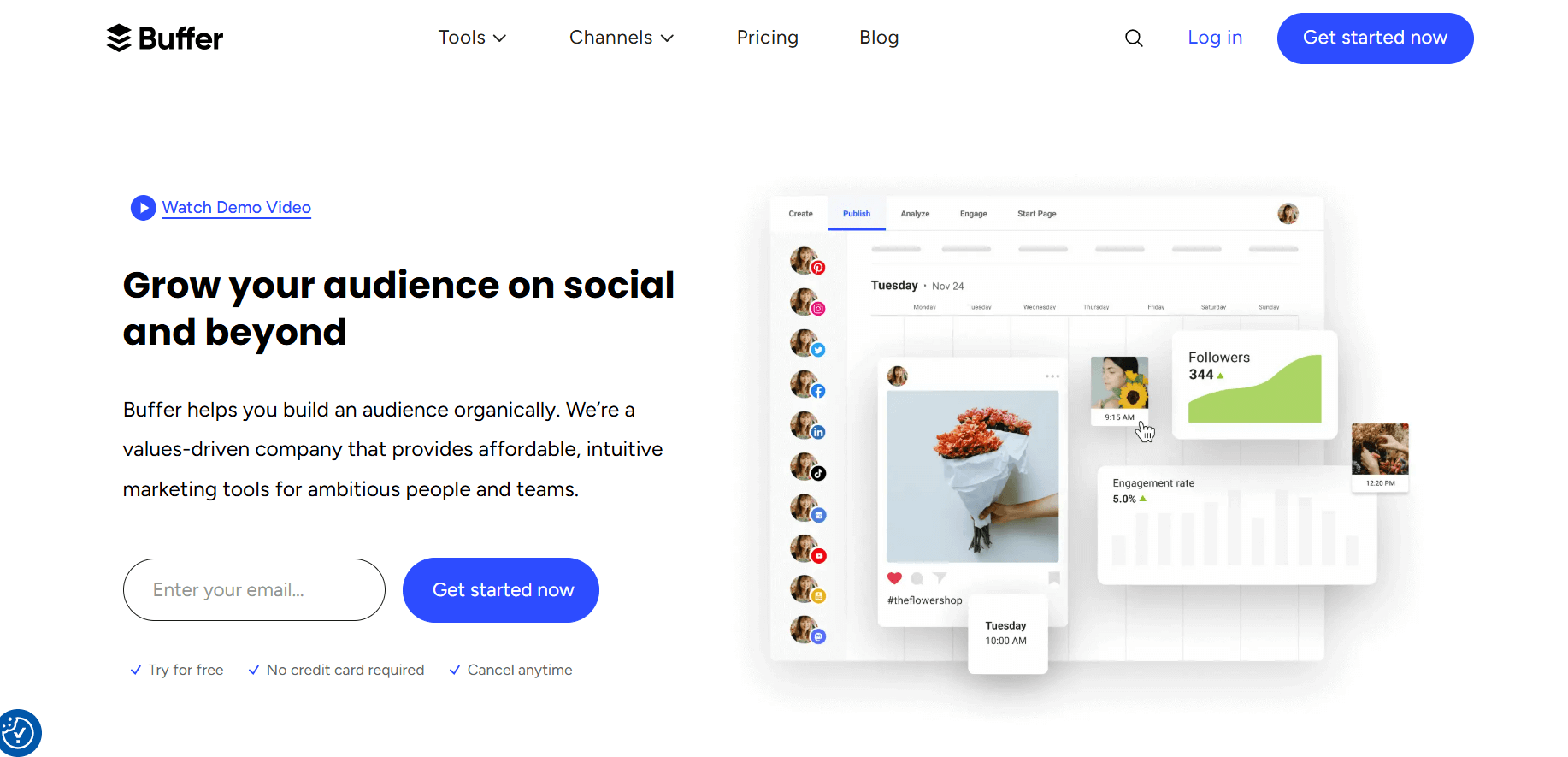
Best for: Freelancers and creators who want a clean, no-frills calendar.
Buffer keeps things deliberately minimal. You connect channels, queue posts, and let them publish. There’s a free plan and a per-channel pricing model that stays cheap if you only run a few accounts.
Key features: Queue-based scheduling, basic analytics, AI caption assistant, and a tidy mobile app.
Pricing: Free for 3 channels; paid plans from $6/channel/month.
Pros: Easy to learn; genuinely useful free tier; predictable pricing for one or two accounts.
Cons: No built-in design or video tools; per-channel pricing adds up fast across many accounts; analytics are light.
3. Hootsuite — best for mid-size teams with listening needs
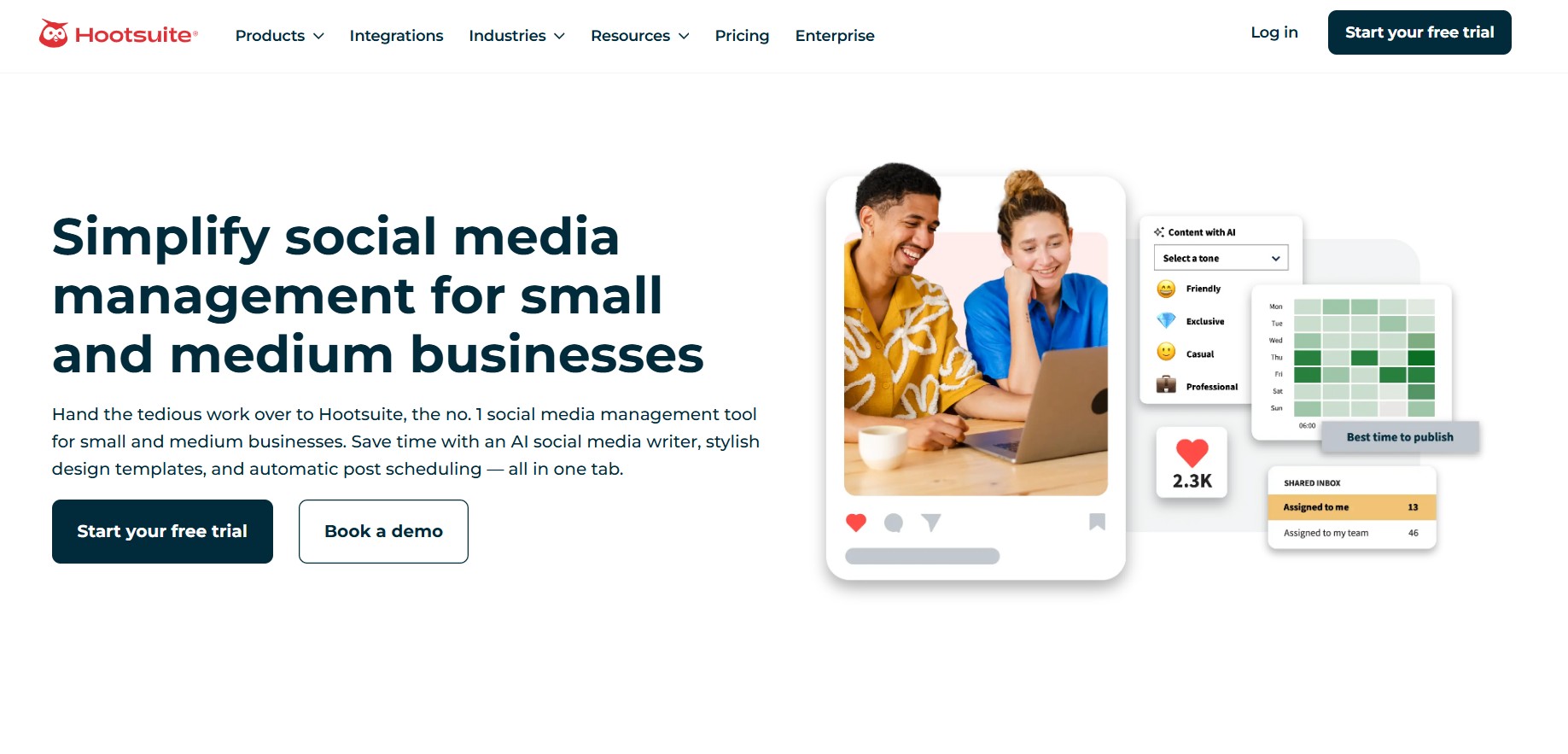
Best for: Teams that need scheduling plus social listening and approvals.
Hootsuite is the legacy dashboard. It does scheduling, monitoring, and team workflows well, but you pay for it—and you create content elsewhere, then import it.
Key features: Multi-account scheduling, social listening, team approval flows, bulk scheduling, and analytics.
Pricing: Professional from $99/month.
Pros: Mature feature set; strong listening and reporting; handles many accounts.
Cons: Expensive entry point; no content creation tools; interface feels heavy for solo users.
4. Later — best for visual Instagram and TikTok planning

Best for: Creators who plan content around a visual grid.
Later started as an Instagram tool and still shines at visual planning. The drag-and-drop calendar and grid preview make it easy to see how a feed will look before it goes live.
Key features: Visual content calendar, Instagram grid preview, link-in-bio tool, and best-time-to-post suggestions.
Pricing: Plans from $25/month; limited free option.
Pros: Excellent for image-first platforms; intuitive grid view; solid link-in-bio.
Cons: Less suited to text-heavy platforms; analytics gated to higher tiers; no AI writing or design depth.
5. Sprout Social — best for enterprise analytics
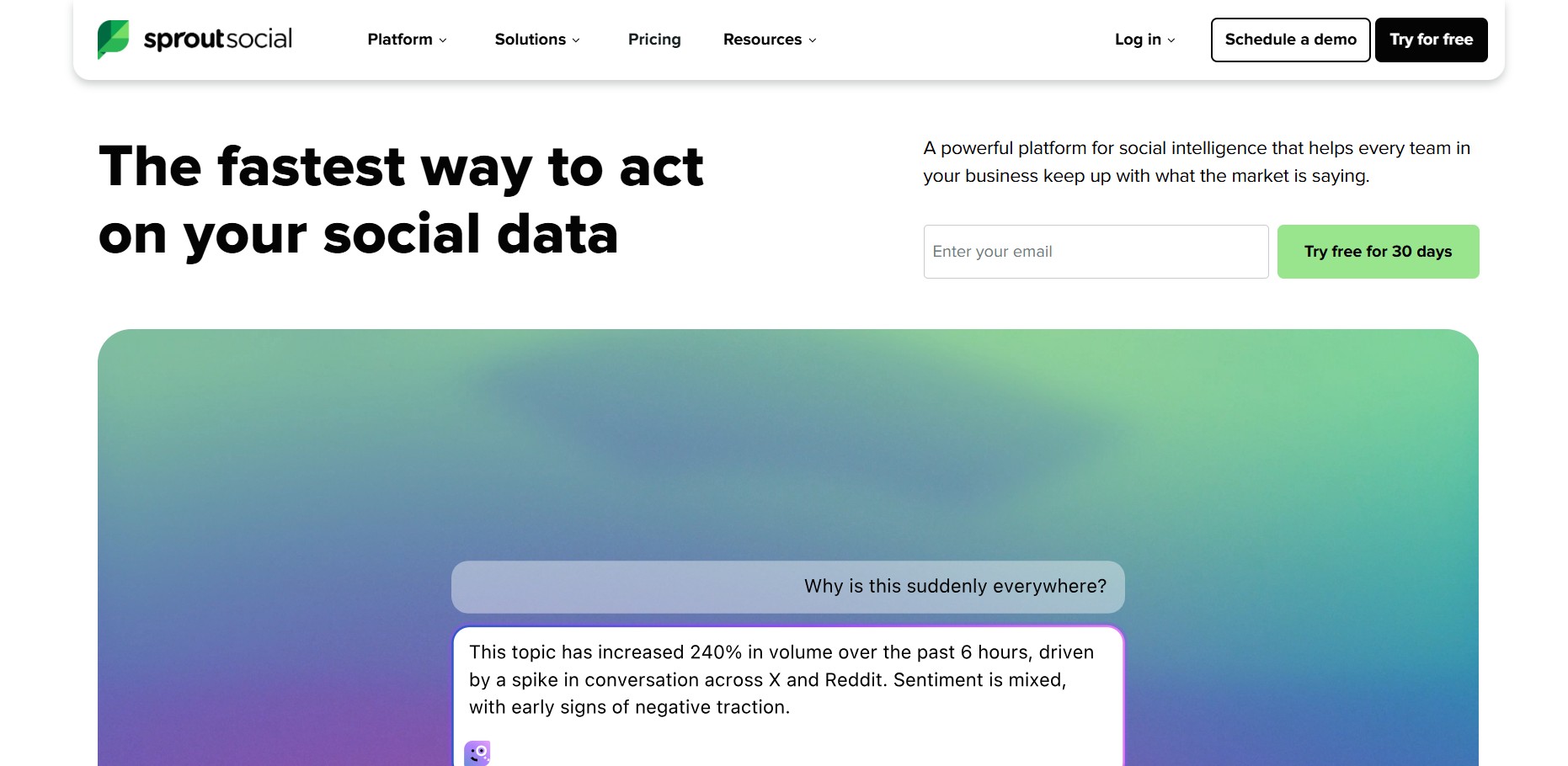
Best for: Larger teams and agencies that need deep reporting and CRM-style features.
Sprout Social is polished and powerful, with the analytics and collaboration tools big teams expect. The catch is price—it’s the most expensive option here by a wide margin.
Key features: Advanced analytics, social listening, smart inbox, approval workflows, and CRM tools.
Pricing: From $199/seat/month.
Pros: Best-in-class reporting; strong team and inbox management; reliable support.
Cons: Steep per-seat cost; overkill for small teams; no native content creation.
6. Postiz — best open-source social media automation tool
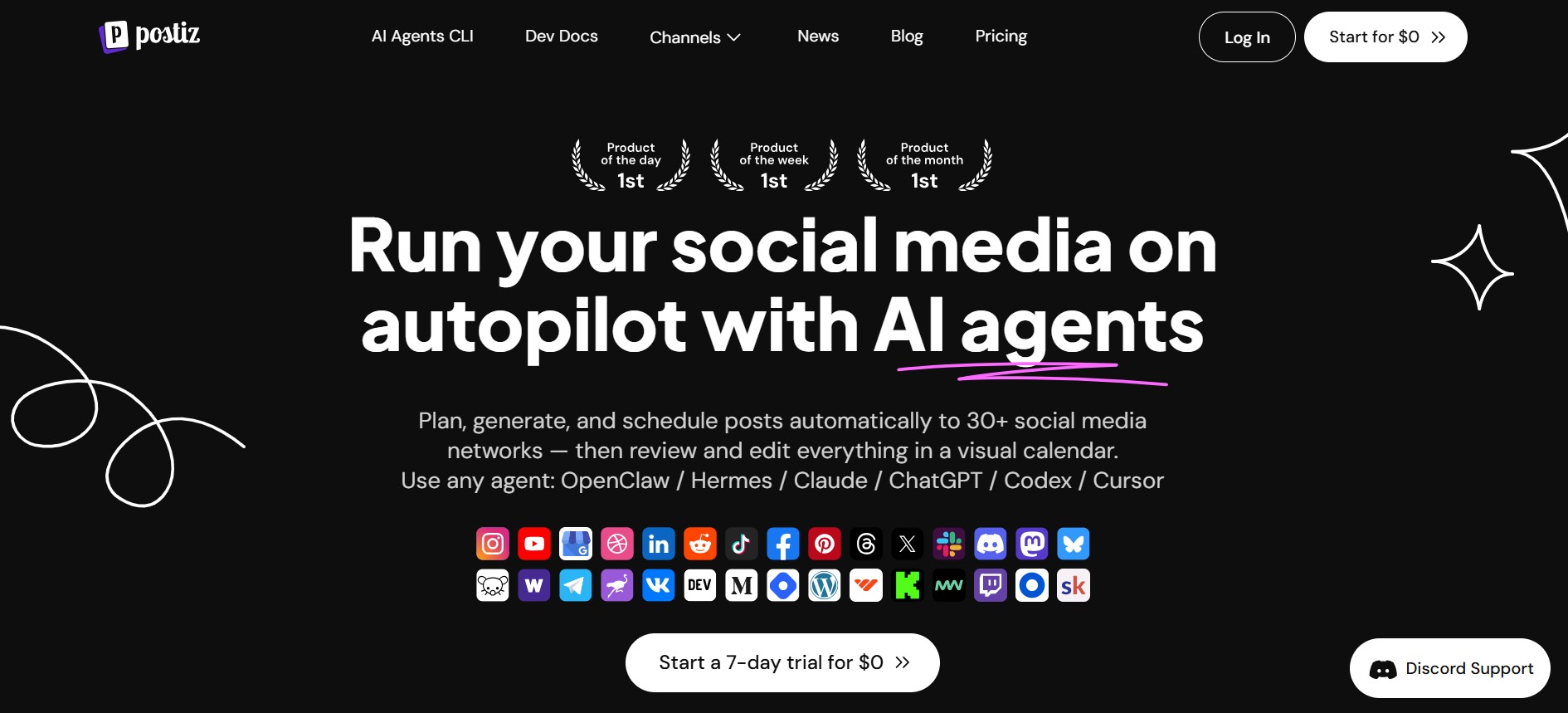
Best for: Developers who want to self-host and avoid subscriptions.
Postiz is an open-source scheduler you can run on your own server. For technical users who value control and data ownership, it’s a strong free social media automation option, with an API for programmatic posting.
Key features: Self-hosted scheduling, multi-platform support, AI assistant, and an API for automation.
Pricing: Free if self-hosted; managed cloud plans available.
Pros: Free and open-source; full data control; API access for scripting.
Cons: Self-hosting requires setup and maintenance; smaller community than commercial tools; you own the upkeep.
7. RecurPost – best for agencies managing multiple social accounts
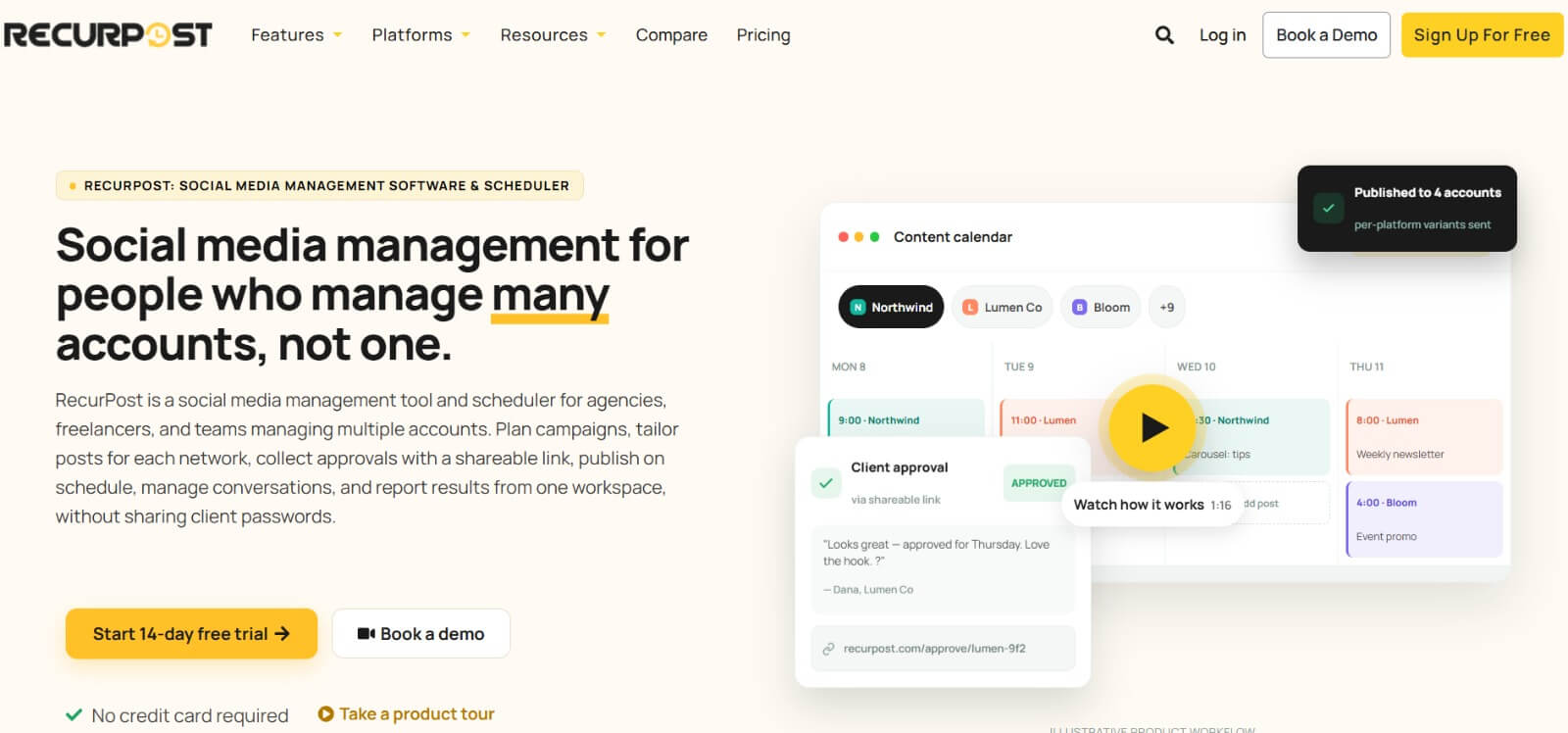
Best for: Agencies, freelancers, and teams that manage multiple social media accounts and need scheduling, content recycling, approvals, and reporting in one workspace.
RecurPost is a social media management and scheduling platform built around multi-account publishing. Instead of managing each client’s social profiles separately, teams can organize content calendars, approvals, publishing, engagement, and reporting from one workspace.
For teams handling large amounts of content, RecurPost supports bulk scheduling through CSV or Excel imports, allowing users to upload 100+ posts across client profiles and tailor content for different social networks before scheduling.
Key features: Visual social media calendar, bulk and CSV scheduling, recurring and seasonal content libraries, per-network post customization, best-time scheduling, client approvals, shareable calendars, unified inbox, analytics, and white-label reports.
Pricing: 14-day free trial; paid plans are available based on the number of social profiles, client workspaces, users, and workflows required.
Pros: Strong multi-account workflow; useful content recycling and seasonal scheduling; bulk scheduling; client approval workflows; platform-specific post customization; analytics and white-label reporting.
8. n8n — best self-hosted workflow automation
Best for: Technical users who want to orchestrate social posting inside larger automations.
n8n is a workflow automation tool, not a scheduler. It connects apps and triggers actions—so you might use it to grab a new blog post and send it to a posting API. It doesn’t publish to social networks on its own; it’s the glue.
Key features: Visual workflow builder, self-hosting option, hundreds of integrations, and custom code nodes.
Pricing: Free self-hosted; paid cloud plans available.
Pros: Powerful and flexible; self-hostable; strong for multi-step automations.
Cons: Not a posting tool by itself; needs a separate social API; learning curve for non-developers.
9. Zapier — best for connecting apps without code
Best for: Non-technical users who want to link tools with simple triggers.
Zapier is the most approachable automation glue. “When this happens, do that.” You can route content into a scheduler or posting tool, but Zapier itself doesn’t manage your social calendar.
Key features: No-code triggers and actions, thousands of app connections, and multi-step Zaps.
Pricing: Free tier; paid plans from $20/month.
Pros: Easy to set up; huge integration library; no coding needed.
Cons: Task-based pricing climbs with volume; not a standalone scheduler; complex flows get pricey.
10. SocialBee — best for category-based content recycling
Best for: Solo marketers who post evergreen content on a rotation.
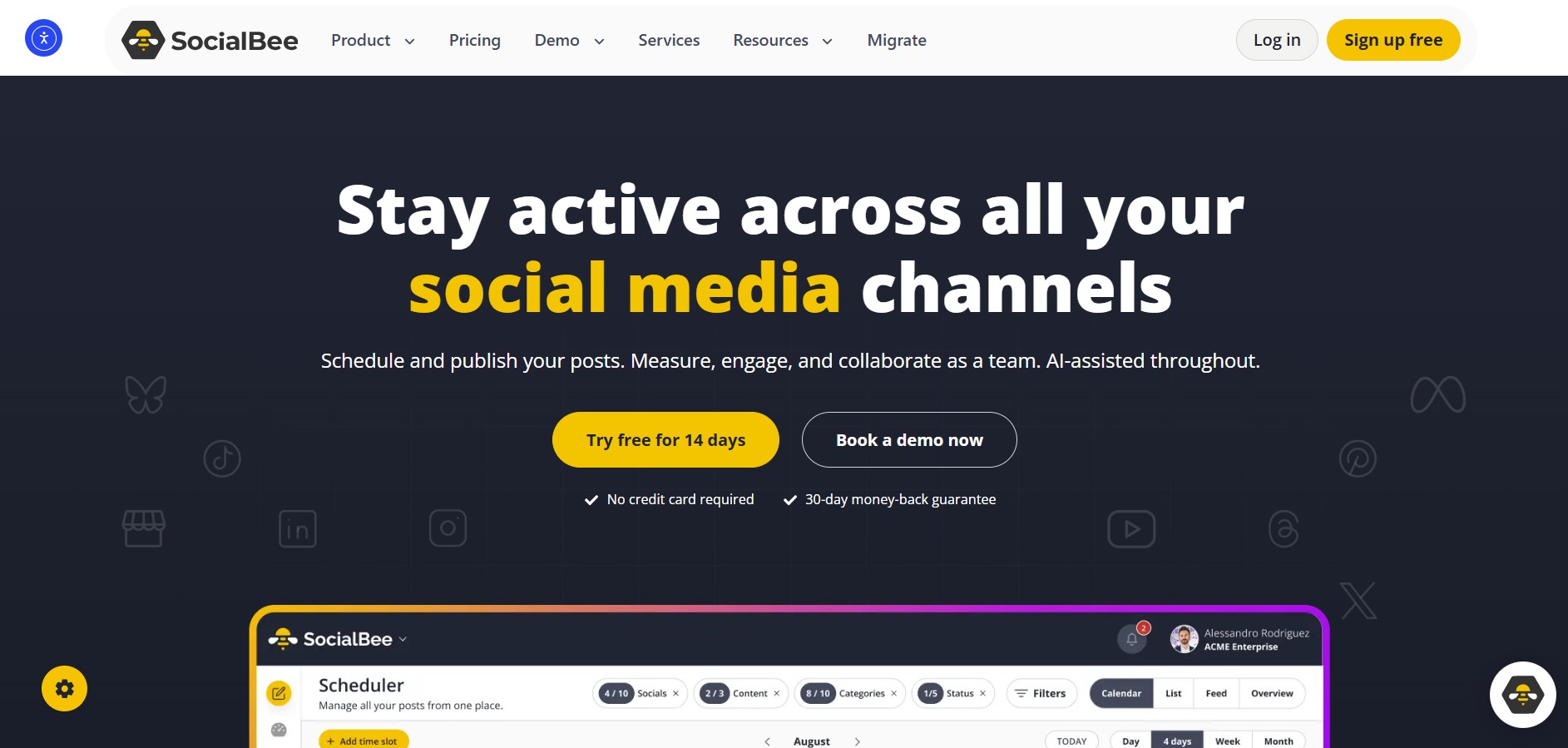
SocialBee organizes posts into categories and recycles them on a schedule—useful if you reshare evergreen tips, quotes, or promotions on repeat. It’s a focused scheduler with a smart twist.
Key features: Category-based queues, content recycling, AI post generation, and basic analytics.
Pricing: From $29/month; free trial only.
Pros: Great for evergreen rotation; affordable for one user; helpful onboarding.
Cons: No free tier; design tools are minimal; recycling setup takes time upfront.
11. Make.com — best visual multi-step automation
Best for: Users who want detailed, branching automations with a visual builder.
Make.com (formerly Integromat) is another orchestrator. Its visual canvas handles complex, branching logic well, and it’s cheaper than Zapier at higher volumes. Like the others in this camp, it routes content rather than scheduling it natively.
Key features: Visual scenario builder, branching logic, hundreds of integrations, and affordable operation pricing.
Pricing: Free tier; paid plans from $9/month.
Pros: Powerful visual logic; cost-effective at scale; flexible.
Cons: Steeper learning curve than Zapier; not a posting tool alone; needs a social API to publish.
12. Ayrshare — best posting API for developers
Best for: Engineering teams that need to add social posting to their own product.
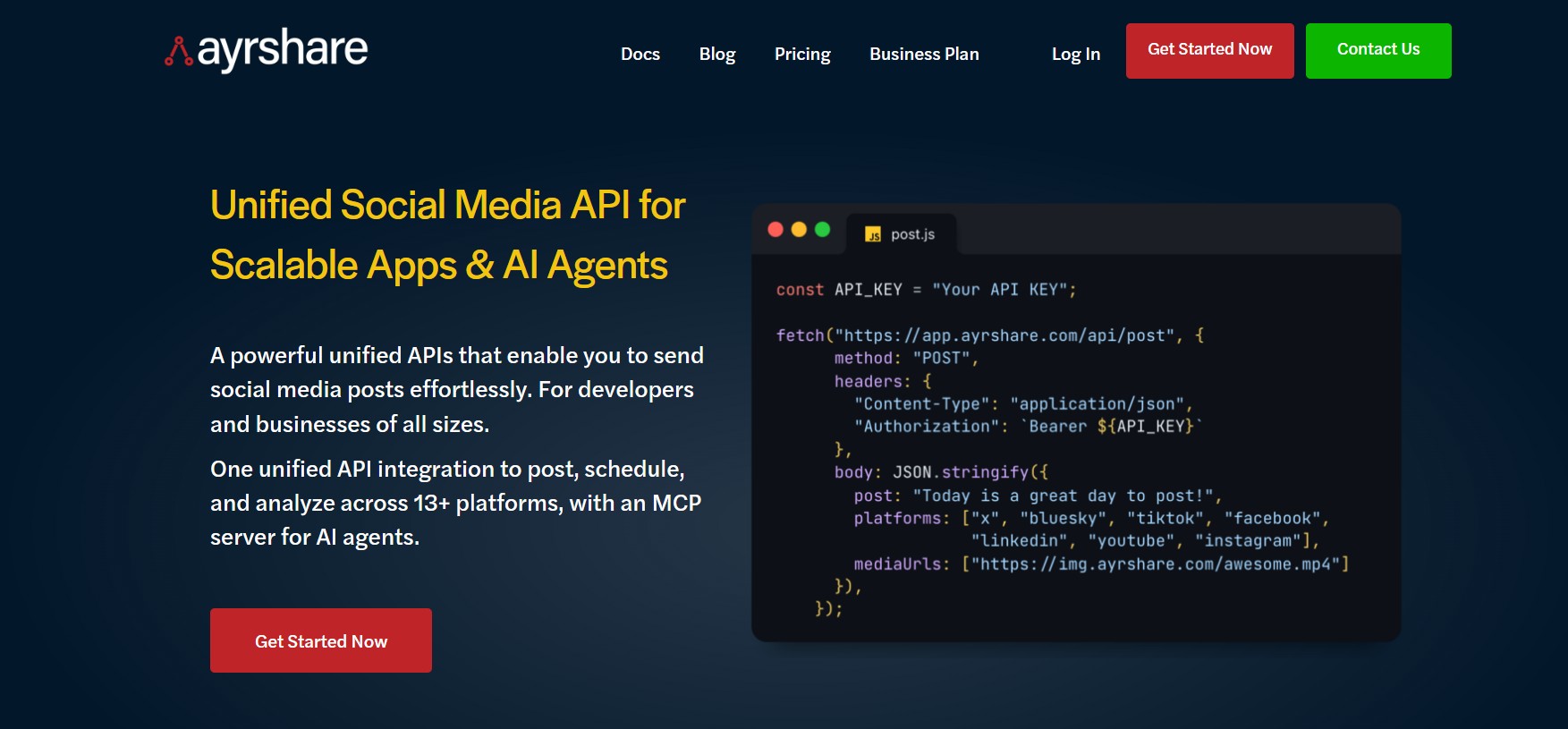
Ayrshare isn’t a dashboard—it’s an API. You send a request, it posts to the connected networks. If you’re building an app that needs to publish on a user’s behalf, this is purpose-built for that job.
Key features: Single REST API for multiple networks, post analytics endpoints, and user-level account management.
Pricing: From $149/month for business use.
Pros: Clean, well-documented API; built for programmatic posting at scale; multi-user support.
Cons: No content creation; business pricing is high for individuals; you build the front end yourself.
How to choose the right social media automation platform
Start with one question: are you a human scheduling posts, or are you building automation that posts for you?
If you’re a creator or small team that wants to create and schedule in one place, Simplified is the strongest fit—and the cheapest entry point for that much capability. If you only need a lightweight calendar, Buffer or Later will do the job. Bigger teams with budget gravitate to Hootsuite or Sprout Social for listening and reporting.
If you’re a developer, the calculus changes. Ayrshare gives you a clean posting API. Postiz lets you self-host for free. And if you want AI agents to run social media end to end, you need JSON output and a headless interface—which is exactly what simplified-cli provides, and what most dashboards don’t.
The orchestrators—n8n, Zapier, and Make.com—are worth adding once you’ve picked a posting tool. They trigger the workflow; your scheduler or API does the posting. For more on where this is heading, read our take on AI agents for social media.
One more honest note: free social media automation tools are real, but they trade convenience for limits. Buffer caps channels, Postiz asks you to host it yourself, and most free plans cap post volume. Match the tradeoff to what you actually need, not the longest feature list.
Bringing it together
Choosing among social media automation tools comes down to fit, not feature counts. Here’s the short version:
- All-in-one creation + scheduling: Simplified, the only CLI-native option and the lowest-cost way to create and post in one workspace.
- Simple dashboards: Buffer and Later for solo creators; Hootsuite and Sprout Social for funded teams.
- Developer and agent use: Ayrshare for a posting API, Postiz for open-source self-hosting, and
simplified-clifor AI agents. - Automation glue: n8n, Zapier, and Make.com to trigger it all.
If you want one platform that creates the content and schedules it—plus a CLI for when you’re ready to automate—start with Simplified’s free plan. No credit card, and you can test the workflow before you commit. Compare options further in our roundup of the Best social media scheduling tools, or see how the AI social media post generator speeds up the writing side.
Frequently asked questions
What are the best free social media automation tools?
The strongest free social media automation tools in 2026 are Buffer (free for 3 channels), Postiz (free when self-hosted), and Simplified’s free plan, which includes scheduling plus AI design and writing credits. Each has limits—Buffer caps channels, Postiz needs your own server, and free plans cap post volume—so pick based on which tradeoff fits your workflow.
Can AI agents post to social media automatically?
Yes. AI agents can post automatically if your tool runs headless and outputs structured data like JSON. Most dashboard schedulers can’t do this because they’re built for humans clicking buttons. Tools like simplified-cli and API-first options such as Ayrshare are designed for it—an agent calls a command or endpoint, and the post publishes without anyone opening a browser.
What’s the difference between a scheduler and an automation orchestrator?
A scheduler (Buffer, Later, Simplified) publishes your posts at set times. An orchestrator (Zapier, n8n, Make.com) connects apps and triggers actions but doesn’t post to social networks itself. In practice you use both: the orchestrator detects an event—like a new blog post—and hands it to the scheduler or a posting API to publish.
Is social media automation software worth it for a small business?
For most small businesses, yes. Automating scheduling alone saves hours each week, and an all-in-one platform that also creates content can replace three or four separate subscriptions—often saving $100 or more per month. The key is choosing software you’ll actually use, not the one with the longest feature list.
How many platforms can these tools post to?
It varies. Simplified publishes to 10 platforms, including Instagram, Facebook, LinkedIn, TikTok, YouTube, Pinterest, Threads, Google Business, Bluesky, and TikTok Business. Most dashboard tools cover the major networks, while API-first tools like Ayrshare support a similar range. Always check that your specific platforms are supported before you commit.